

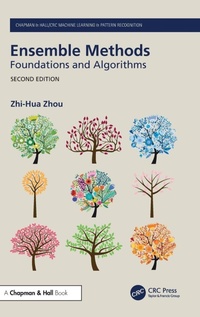
Ensemble Methods
Foundations and Algorithms
2nd Edition
Published on 9. March 2025
Book
Hardback
348 pages
978-1-032-96060-9 (ISBN)
Description
Ensemble methods that train multiple learners and then combine them to use, with Boosting and Bagging as representatives, are well-known machine learning approaches. It has become common sense that an ensemble is usually significantly more accurate than a single learner, and ensemble methods have already achieved great success in various real-world tasks.
Twelve years have passed since the publication of the first edition of the book in 2012 (Japanese and Chinese versions published in 2017 and 2020, respectively). Many significant advances in this field have been developed. First, many theoretical issues have been tackled, for example, the fundamental question of why AdaBoost seems resistant to overfitting gets addressed, so that now we understand much more about the essence of ensemble methods. Second, ensemble methods have been well developed in more machine learning fields, e.g., isolation forest in anomaly detection, so that now we have powerful ensemble methods for tasks beyond conventional supervised learning.
Third, ensemble mechanisms have also been found helpful in emerging areas such as deep learning and online learning. This edition expands on the previous one with additional content to reflect the significant advances in the field, and is written in a concise but comprehensive style to be approachable to readers new to the subject.
Twelve years have passed since the publication of the first edition of the book in 2012 (Japanese and Chinese versions published in 2017 and 2020, respectively). Many significant advances in this field have been developed. First, many theoretical issues have been tackled, for example, the fundamental question of why AdaBoost seems resistant to overfitting gets addressed, so that now we understand much more about the essence of ensemble methods. Second, ensemble methods have been well developed in more machine learning fields, e.g., isolation forest in anomaly detection, so that now we have powerful ensemble methods for tasks beyond conventional supervised learning.
Third, ensemble mechanisms have also been found helpful in emerging areas such as deep learning and online learning. This edition expands on the previous one with additional content to reflect the significant advances in the field, and is written in a concise but comprehensive style to be approachable to readers new to the subject.
More details
Series
Edition
2nd edition
Language
English
Place of publication
United Kingdom
Publishing group
Taylor & Francis Ltd
Target group
Professional and scholarly
Professional Practice & Development
Illustrations
27 s/w Abbildungen, 43 farbige Abbildungen, 27 s/w Zeichnungen, 43 farbige Zeichnungen, 4 s/w Tabellen
4 Tables, black and white; 43 Line drawings, color; 27 Line drawings, black and white; 43 Illustrations, color; 27 Illustrations, black and white
Dimensions
Height: 240 mm
Width: 161 mm
Thickness: 24 mm
Weight
710 gr
ISBN-13
978-1-032-96060-9 (9781032960609)
Copyright in bibliographic data and cover images is held by Nielsen Book Services Limited or by the publishers or by their respective licensors: all rights reserved.
Schweitzer Classification
Other editions
Additional editions

E-Book
02/2025
2nd Edition
Chapman and Hall
€63.49
Available for download

E-Book
02/2025
2nd Edition
Chapman and Hall
€63.49
Available for download
Previous edition

Book
06/2012
1st Edition
Chapman & Hall/CRC
€111.50
Article exhausted; check for reprint
Person
Zhi-Hua Zhou, Professor of Computer Science and Artificial Intelligence at Nanjing University, President of IJCAI trustee, Fellow of the ACM, AAAI, AAAS, IEEE, recipient of the IEEE Computer Society Edward J. McCluskey Technical Achievement Award, CCF-ACM Artificial Intelligence Award.
Content
Preface Notations 1. Introduction 2. Boosting 3. Bagging 4. Combination Methods 5. Diversity 6. Ensemble Pruning 7. Clustering Ensemble 8. Anomaly Detection and Isolation Forest 9. Semi-Supervised Ensemble 10. Class-Imbalance and Cost-Sensitive Ensemble 11. Deep Learning and Deep Forest 12. Advanced Topics References Index