

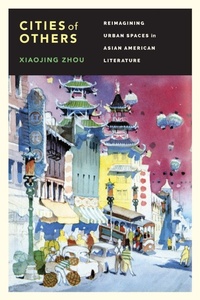
Cities of Others
Reimagining Urban Spaces in Asian American Literature
Published on 1. December 2014
Book
Paperback/Softback
344 pages
978-0-295-99403-1 (ISBN)
Description
Asian American literature abounds with complex depictions of American cities as spaces that reinforce racial segregation and prevent interactions across boundaries of race, culture, class, and gender. However, in Cities of Others, Xiaojing Zhou uncovers a much different narrative, providing the most comprehensive examination to date of how Asian American writers - both celebrated and overlooked - depict urban settings. Zhou goes beyond examining popular portrayals of Chinatowns by paying equal attention to life in other parts of the city. Her innovative and wide-ranging approach sheds new light on the works of Chinese, Filipino, Indian, Japanese, Korean, and Vietnamese American writers who bear witness to a variety of urban experiences and reimagine the American city as other than a segregated nation-space.
Drawing on critical theories on space from urban geography, ecocriticism, and postcolonial studies, Zhou shows how spatial organization shapes identity in the works of Sui Sin Far, Bienvenido Santos, Meena Alexander, Frank Chin, Chang-rae Lee, Karen Tei Yamashita, and others. She also shows how the everyday practices of Asian American communities challenge racial segregation, reshape urban spaces, and redefine the identity of the American city. From a reimagining of the nineteenth-century flaneur figure in an Asian American context to providing a framework that allows readers to see ethnic enclaves and American cities as mutually constitutive and transformative, Zhou gives us a provocative new way to understand some of the most important works of Asian American literature.
Drawing on critical theories on space from urban geography, ecocriticism, and postcolonial studies, Zhou shows how spatial organization shapes identity in the works of Sui Sin Far, Bienvenido Santos, Meena Alexander, Frank Chin, Chang-rae Lee, Karen Tei Yamashita, and others. She also shows how the everyday practices of Asian American communities challenge racial segregation, reshape urban spaces, and redefine the identity of the American city. From a reimagining of the nineteenth-century flaneur figure in an Asian American context to providing a framework that allows readers to see ethnic enclaves and American cities as mutually constitutive and transformative, Zhou gives us a provocative new way to understand some of the most important works of Asian American literature.
Reviews / Votes
"Zhou expands the intellectual horizon by moving beyond the critique of ethnic enclave as simply space of marginalization and by arguing that Chinatown mutually constitutes and transforms the US city and provides an alternative space for Asian American everyday practice as well as reimagining of a national subject. . . . Highly recommended."(Choice) "Zhou tracks how authors such as Sui Sin Far, Lin Yutang, Fae Myenne Ng, and Frank Chin render alienated Asian immigrant characters as immersed in a series of urban interactions that on one level resists social marginalization and isolation and on another level imagines a sense of belonging, enacting a spatial citizenship and transforming the contours of being American... Zhou's more ambitious aim is to show how Asian American literature reimagines and re-represents the American city... The close readings of novels are comprehensive and insightful."
(American Literature)
More details
Series
Language
English
Place of publication
Seattle
United States
Target group
Professional and scholarly
Product notice
Paperback (trade)
Dimensions
Height: 229 mm
Width: 152 mm
Thickness: 20 mm
Weight
562 gr
ISBN-13
978-0-295-99403-1 (9780295994031)
Copyright in bibliographic data and cover images is held by Nielsen Book Services Limited or by the publishers or by their respective licensors: all rights reserved.
Schweitzer Classification
Other editions
Additional editions
E-Book
12/2014
1st Edition
University of Washington Press
€30.99
Available for download
Person
Xiaojing Zhou is professor of English at the University of the Pacific.
Content
Acknowledgments
Introduction Contested Urban Space
1. "The Woman about Town": Transgressing Raced and Gendered Boundaries in Sui Sin Far's Writings
2. Claiming Right to the City: Lin Yutang's Chinatown Family
3. "Our Inside Story" of Chinatown: Fae Myenne Ng's Bone
4. Chinatown as an Embattled Pedagogical Space: Frank Chin's Short Story Cycle and Donald Duk
5. Inhabiting the City as Exiles: Bienvenido N. Santos's What the Hell for You Left Your Heart in San Francisco
6. The City as a "Contact Zone": Meena Alexander's Manhattan Music
7. "The Living Voice of the City": Chang-rae Lee's Native Speaker
8. Mapping the Global City and "the Other Scene" of Globalization: Karen Tei Yamashita's Tropic of Orange
Conclusion The I-Hotel and Other Places
Notes
Bibliography
Index
Introduction Contested Urban Space
1. "The Woman about Town": Transgressing Raced and Gendered Boundaries in Sui Sin Far's Writings
2. Claiming Right to the City: Lin Yutang's Chinatown Family
3. "Our Inside Story" of Chinatown: Fae Myenne Ng's Bone
4. Chinatown as an Embattled Pedagogical Space: Frank Chin's Short Story Cycle and Donald Duk
5. Inhabiting the City as Exiles: Bienvenido N. Santos's What the Hell for You Left Your Heart in San Francisco
6. The City as a "Contact Zone": Meena Alexander's Manhattan Music
7. "The Living Voice of the City": Chang-rae Lee's Native Speaker
8. Mapping the Global City and "the Other Scene" of Globalization: Karen Tei Yamashita's Tropic of Orange
Conclusion The I-Hotel and Other Places
Notes
Bibliography
Index