

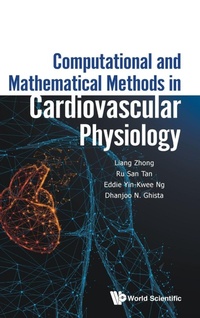
Computational And Mathematical Methods In Cardiovascular Physiology
Published on 8. May 2019
Book
Hardback
460 pages
978-981-327-063-3 (ISBN)
Description
Cardiovascular diseases (CVD) including heart diseases, peripheral vascular disease and heart failure, account for one-third of deaths throughout the world. CVD risk factors include systolic blood pressure, total cholesterol, high-density lipoprotein cholesterol, and diabetic status. Clinical trials have demonstrated that when modifiable risk factors are treated and corrected, the chances of CVD occurring can be reduced. This illustrates the importance of this book's elaborate coverage of cardiovascular physiology by the application of mathematical and computational methods.This book has literally transformed Cardiovascular Physiology into a STEM discipline, involving (i) quantitative formulations of heart anatomy and physiology, (ii) technologies for imaging the heart and blood vessels, (iii) coronary stenosis hemodynamics measure by means of fractional flow reserve and intervention by grafting and stenting, (iv) fluid mechanics and computational analysis of blood flow in the heart, aorta and coronary arteries, and (v) design of heart valves, percutaneous valve stents, and ventricular assist devices.So how is this mathematically and computationally configured landscape going to impact cardiology and even cardiac surgery? We are now entering a new era of mathematical formulations of anatomy and physiology, leading to technological formulations of medical and surgical procedures towards more precise medicine and surgery. This will entail reformatting of (i) the medical MD curriculum and courses, so as to educate and train a new generation of physicians who are conversant with medical technologies for applying into clinical care, as well as (ii) structuring of MD-PhD (Computational Medicine and Surgery) Program, to train competent medical and surgical specialists in precision medical care and patient-specific surgical care.This book provides a gateway for this new emerging scenario of (i) science and engineering based medical educational curriculum, and (ii) technologically oriented medical and surgical procedures. As such, this book can be usefully employed as a textbook for courses in (i) cardiovascular physiology in both the schools of engineering and medicine of universities, as well as (ii) cardiovascular engineering in biomedical engineering departments worldwide.
More details
Language
English
Place of publication
Singapore
Singapore
Target group
College/higher education
Professional and scholarly
Dimensions
Height: 235 mm
Width: 157 mm
Thickness: 29 mm
Weight
809 gr
ISBN-13
978-981-327-063-3 (9789813270633)
Copyright in bibliographic data and cover images is held by Nielsen Book Services Limited or by the publishers or by their respective licensors: all rights reserved.
Schweitzer Classification