

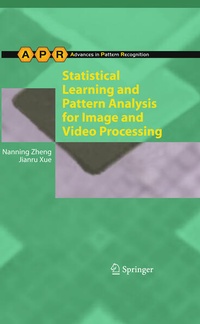
Statistical Learning and Pattern Analysis for Image and Video Processing
Published on 16. April 2010
Book
Hardback
XVI, 365 pages
978-1-84882-311-2 (ISBN)
Description
Why are We Writing This Book? Visual data (graphical, image, video, and visualized data) affect every aspect of modern society. The cheap collection, storage, and transmission of vast amounts of visual data have revolutionized the practice of science, technology, and business. Innovations from various disciplines have been developed and applied to the task of designing intelligent machines that can automatically detect and exploit useful regularities (patterns) in visual data. One such approach to machine intelligence is statistical learning and pattern analysis for visual data. Over the past two decades, rapid advances have been made throughout the ?eld of visual pattern analysis. Some fundamental problems, including perceptual gro- ing,imagesegmentation, stereomatching, objectdetectionandrecognition,and- tion analysis and visual tracking, have become hot research topics and test beds in multiple areas of specialization, including mathematics, neuron-biometry, and c- nition. A great diversity of models and algorithms stemming from these disciplines has been proposed. To address the issues of ill-posed problems and uncertainties in visual pattern modeling and computing, researchers have developed rich toolkits based on pattern analysis theory, harmonic analysis and partial differential eq- tions, geometry and group theory, graph matching, and graph grammars. Among these technologies involved in intelligent visual information processing, statistical learning and pattern analysis is undoubtedly the most popular and imp- tant approach, and it is also one of the most rapidly developing ?elds, with many achievements in recent years. Above all, it provides a unifying theoretical fra- work for intelligent visual information processing applications.
Reviews / Votes
From the reviews:
"The level for which the text was aimed was quite introductory, giving a well executed explanation of not just the technique, but also the supporting techniques. This would serve the book well as a tool to someone learning the technique from new . . Overall I enjoyed the book . . I found that the subjects were well discussed and at a level that suited my knowledge. I would recommend it as a general purpose book for image and video analysis . ." (Gavin Powell, International Association for Pattern Recognition, Vol. 32 (3), July, 2010)More details
Series
Edition
2009 ed.
Language
English
Place of publication
London
United Kingdom
Target group
Professional and scholarly
Research
Illustrations
XVI, 365 p.
Dimensions
Height: 241 mm
Width: 160 mm
Thickness: 29 mm
Weight
811 gr
ISBN-13
978-1-84882-311-2 (9781848823112)
DOI
10.1007/978-1-84882-312-9
Schweitzer Classification
Other editions
Additional editions
Nanning Zheng | Jianru Xue
Statistical Learning and Pattern Analysis for Image and Video Processing
Book
03/2012
Springer
€160.49
Shipment within 15-20 days
Nanning Zheng | Jianru Xue
Statistical Learning and Pattern Analysis for Image and Video Processing
E-Book
07/2009
1st Edition
Springer
€149.79
Available for download
Persons
Badong Chen received the B.S. and M.S. degrees in Control Theory and Engineering from Chongqing University, Chongqing, China, in 1997 and 2003, respectively, and the Ph.D. degree in Computer Science and Technology from Tsinghua University, Beijing, China, in 2008. He was a Postdoctoral Associate at the University of Florida Computational NeuroEngineering Laboratory (CNEL) from 2010 to 2012. He visited the Nanyang Technological University (NTU), Singapore, as a visiting research scientist in 2015. He also served as a senior research fellow with The Hong Kong Polytechnic University in 2017. Currently he is a professor at the Institute of Artificial Intelligence and Robotics (IAIR), Xi'an Jiaotong University, Xi'an, China. His research interests are in signal processing, machine learning, artificial intelligence, neural engineering and robotics. He has published two books and over 200 papers in various journals and conference proceedings and his papers have got over 5500 citations according to Google Scholar. Dr. Chen is an IEEE Senior Member, a Technical Committee Member of IEEE SPS Machine Learning for Signal Processing (MLSP) and IEEE CIS Cognitive and Developmental Systems (CDS), and an associate editor of IEEE Transactions on Cognitive and Developmental Systems, IEEE Transactions on Neural Networks and Learning Systems and Journal of The Franklin Institute and has been on the editorial board of Entropy.
Lujuan Dang received the B.S. degree in information science and technology from Northwest University, Xi'an, China, in 2015, and the M.S. degree in electronic and information engineering from Southwest University, Chongqing, China, in 2018. She is currently pursuing the Ph.D. degree with the Institute of Artificial Intelligence and Robotics, Xi'an Jiaotong University, Xi'an. Her current interests focus on adaptive filtering and information theoretic learning.
Nanning Zheng graduated from the Department of Electrical Engineering, Xi'an Jiaotong University, Xi'an, China, in 1975, and received the M.S. degree in information and control engineering from Xi'an Jiaotong University in 1981 and the Ph.D. degree in electrical engineering from Keio University, Yokohama, Japan, in 1985. He is currently a professor and director of the Institute of Artificial Intelligence and Robotics, Xi'an Jiaotong University. His research interests include computer vision, pattern recognition and image processing, and hardware implementation of intelligent systems. Prof. Zheng became a member of the Chinese Academy of Engineering in 1999, and he is the Chinese Representative on the Governing Board of the International Association for Pattern Recognition. He is an IEEE Fellow and serves as an executive deputy editor of the Chinese Science Bulletin.
Jose C. Principe is a Distinguished Professor of Electrical and Computer Engineering at the University of Florida where he teaches advanced signal processing, machine learning and artificial neural networks (ANNs). He is the Eckis Professor and the Founder and Director of the University of Florida Computational NeuroEngineering Laboratory (CNEL) www.cnel.ufl.edu. The CNEL Lab innovated signal and pattern recognition principles based on information theoretic criteria, as well as filtering in functional spaces. His secondary area of interest has focused in applications to computational neuroscience, Brain Machine Interfaces and brain dynamics. Dr. Principe is a Fellow of the AAAS, IEEE, NAI, AIMBE, and IAMBE. He received the Gabor Award from the INNS, the Shannon- Nyquist Technical Achievement Award from the IEEE Signal Processing Society, the Career Achievement Award from the IEEE EMBS and the Neural Network Pioneer Award of the IEEE CIS. He has more than 33 patents awarded and over 900 publications in the areas of adaptive signal processing, control of nonlinear dynamical systems, machine learning and neural networks, information theoretic learning, wi
Content
Pattern Analysis and Statistical Learning.- Unsupervised Learning for Visual Pattern Analysis.- Component Analysis.- Manifold Learning.- Functional Approximation.- Supervised Learning for Visual Pattern Classification.- Statistical Motion Analysis.- Bayesian Tracking of Visual Objects.- Probabilistic Data Fusion for Robust Visual Tracking.- Multitarget Tracking in Video-Part I.- Multi-Target Tracking in Video - Part II.- Information Processing in Cognition Process and New Artificial Intelligent Systems.