

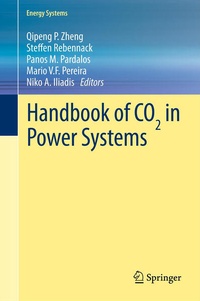
Handbook of CO² in Power Systems
Published on 7. June 2012
Book
Hardback
VIII, 400 pages
978-3-642-27430-5 (ISBN)
Description
The Handbook of CO²in Power Systems' objective is to include the state-of-the-art developments that occurred in power systems taking CO²emission into account. The book includes power systems operation modeling with CO²emissions considerations, CO²market mechanism modeling, CO²regulation policy modeling, carbon price forecasting, and carbon capture modeling. For each of the subjects, at least one article authored by a world specialist on the specific domain is included.
More details
Series
Edition
2012
Language
English
Place of publication
Berlin
Germany
Publishing group
Springer Berlin
Target group
Professional and scholarly
Research
Illustrations
VIII, 400 p.
Dimensions
Height: 241 mm
Width: 160 mm
Thickness: 27 mm
Weight
776 gr
ISBN-13
978-3-642-27430-5 (9783642274305)
DOI
10.1007/978-3-642-27431-2
Schweitzer Classification
Other editions
Additional editions
Qipeng P. Zheng | Steffen Rebennack | Panos M. Pardalos
Handbook of CO² in Power Systems
Book
07/2014
Springer
€106.99
Shipment within 7-9 days
Qipeng P. Zheng | Steffen Rebennack | Panos M. Pardalos
Handbook of CO² in Power Systems
E-Book
06/2012
1st Edition
Springer
€96.29
Available for download
Persons
Qipeng Phil Zheng is an Assistant Professor at the West Virginia University. Steffen Rebennack is an Assistant Professor at the Colorado School of Mines. Panos Pardalos is a Distinguished Professor at the University of Florida. He is also the Director of the Center of Applied Optimization and affiliated with the National Research University Higher School of Economics in Russia. Niko A. Iliadis works with EnerCoRD - Energy Consulting, Research and Development in Athens, Greece. Mario V. F. Pereira works with Power System Research in Rio de Janeiro, Brasil.
Content
Introduction.- I. Operation System Optimization.- II. Portfolio Operation Optimization.- III. Carbon Capture and Sequestration modeling.- IV. Market mechanisms modeling.- V. System Expansion Optimization.- VI. Carbon funds modeling.- VII. CO2 price forecasting.- VIII. CO2 and other emissions.- IX. CO2 regulation modeling.