

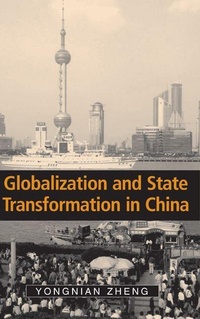
Globalization and State Transformation in China
Published on 11. December 2003
Book
Hardback
288 pages
978-0-521-83050-8 (ISBN)
Description
Globalization has thrown up challenges and opportunities which all countries have to grapple with. In his 2004 book, Yongnian Zheng explores how China's leaders have embraced global capitalism and market-oriented modernization. He shows that with reform measures properly implemented, the nation-state can not only survive globalization, but can actually be revitalized through outside influence. To adapt to the globalized age, Chinese leaders have encouraged individual enterprise and the development of the entrepreneurial class. The state bureaucratic system and other important economic institutions have been restructured to accommodate a globalized market economy. In rebuilding the economic system in this way, Zheng observes that Chinese leaders have been open to the importation of Western ideas. By contrast, the same leaders are reluctant to import Western concepts of democracy and the rule of law. The author argues that, ultimately, this selectivity will impede China's progress in becoming a modern nation state.
More details
Series
Language
English
Place of publication
Cambridge
United Kingdom
Target group
Professional and scholarly
College/higher education
Illustrations
37 Tables, unspecified
Dimensions
Height: 235 mm
Width: 157 mm
Thickness: 22 mm
Weight
622 gr
ISBN-13
978-0-521-83050-8 (9780521830508)
Copyright in bibliographic data and cover images is held by Nielsen Book Services Limited or by the publishers or by their respective licensors: all rights reserved.
Schweitzer Classification
Other editions
Additional editions
Yongnian Zheng
Globalization and State Transformation in China
E-Book
04/2006
1st Edition
Cambridge University Press
€35.49
Available for download
Person
Yongnian Zheng is Associate Professor at the East Asian Institute, National University of Singapore. His previous publications include Discovering Chinese Nationalism (1999) and China's Post-Jiang Leadership Succession (2002).
Content
1. Globalization: state decline or state rebuilding?; 2. State, leadership and globalization; 3. Globalism, nationalism and selective importation; 4. Power, interests, and the justification of capitalism; 5. Bureaucratic reform and market accommodation, 1982-98; 6. Building a modern economic state; 7. State rebuilding, popular protest and collective action; 8. Contending visions of the Chinese state; 9. Globalization: towards a rule-based state governance?