

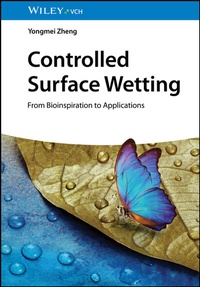
Controlled Surface Wetting
From Bioinspiration to Applications
1st Edition
Published on 2. April 2025
Book
Hardback
320 pages
978-3-527-35289-0 (ISBN)
Description
Comprehensive resource covering the latest development of surface engineering inspired by nature with a special focus on wetting control
Drawing from the natural abilities of plants and animals around the world, Controlled Surface Wetting takes a deep dive into wetting-controlled systems of biological surfaces with information on mechanisms, theory, surface design, fabrication, and effects. This book guides readers to design better engineering surfaces for applications in self-cleaning, water harvesting and repellency, anti-icing, liquid-transport, and beyond.
Exploring the latest literature, this book introduces bioinspired techniques and methods to design wetting-controlled surfaces by using organic or inorganic materials, including those with high/low surface energy, regular/irregular, ordered/disordered, or rough/smooth surfaces, or endless arrangements and combinations of micro- and nanostructures of various styles.
This book begins by introducing biological surfaces such as plant leaves and duck feathers, butterfly wings, and spider silks, as well as their functions, including superhydrophobic properties, water repellency, and capturing tiny water droplets, respectively, progressing through to more advanced topics such as dually-mobile super-repellency, multi-liquid repellency, and switchable repellency in both air and liquid.
Controlled Surface Wetting includes discussion on:
* Fundamental wetting theories, extension and theoretical models, wetting dynamics and kinetics, physics of wetting, wetting adhesion, and wetting chemistry
* Static and dynamic gradients, texture gradients such as gradient polymers, wedge- and helical-induced gradients, and synergism of multi-gradients
* Formation, control, and instability of Rayleigh instability, microfluidics, fluid-coating, electrospinning, fluid diffusion, and laser techniques
* Coalesced-droplet vertical transport, the hierarchical droplet size-effect, atmospheric water harvesting, and energy harvesting
* Artificial skins and sensors, including artificial skin vision, and medical applications, including directional-controllable drug delivery
Controlled Surface Wetting is an up-to-date and completely comprehensive resource for students and researchers in chemistry, physics, and materials science seeking to learn about the design of smart and advanced materials for engineering applications.
Drawing from the natural abilities of plants and animals around the world, Controlled Surface Wetting takes a deep dive into wetting-controlled systems of biological surfaces with information on mechanisms, theory, surface design, fabrication, and effects. This book guides readers to design better engineering surfaces for applications in self-cleaning, water harvesting and repellency, anti-icing, liquid-transport, and beyond.
Exploring the latest literature, this book introduces bioinspired techniques and methods to design wetting-controlled surfaces by using organic or inorganic materials, including those with high/low surface energy, regular/irregular, ordered/disordered, or rough/smooth surfaces, or endless arrangements and combinations of micro- and nanostructures of various styles.
This book begins by introducing biological surfaces such as plant leaves and duck feathers, butterfly wings, and spider silks, as well as their functions, including superhydrophobic properties, water repellency, and capturing tiny water droplets, respectively, progressing through to more advanced topics such as dually-mobile super-repellency, multi-liquid repellency, and switchable repellency in both air and liquid.
Controlled Surface Wetting includes discussion on:
* Fundamental wetting theories, extension and theoretical models, wetting dynamics and kinetics, physics of wetting, wetting adhesion, and wetting chemistry
* Static and dynamic gradients, texture gradients such as gradient polymers, wedge- and helical-induced gradients, and synergism of multi-gradients
* Formation, control, and instability of Rayleigh instability, microfluidics, fluid-coating, electrospinning, fluid diffusion, and laser techniques
* Coalesced-droplet vertical transport, the hierarchical droplet size-effect, atmospheric water harvesting, and energy harvesting
* Artificial skins and sensors, including artificial skin vision, and medical applications, including directional-controllable drug delivery
Controlled Surface Wetting is an up-to-date and completely comprehensive resource for students and researchers in chemistry, physics, and materials science seeking to learn about the design of smart and advanced materials for engineering applications.
More details
Edition
1. Auflage
Language
English
Place of publication
Berlin
Germany
Target group
Professional and scholarly
Illustrations
18
1 s/w Abbildung, 17 farbige Abbildungen
1 schwarz-weiße und 17 farbige Abbildungen
Dimensions
Height: 247 mm
Width: 175 mm
Thickness: 21 mm
Weight
772 gr
ISBN-13
978-3-527-35289-0 (9783527352890)
Schweitzer Classification
Other editions
Additional editions
E-Book
02/2025
1st Edition
Wiley-VCH
€129.99
Available for download
Person
Yongmei Zheng, PhD, is a professor at Key Laboratory of Bio-Inspired Smart Interfacial Science and Technology of Ministry of Education, School of Chemistry, Beihang University, Beijing. Her research interests are focused on bioinspired surfaces with gradient micro- and nanostructures to control dynamic wettability and develop the surfaces and materials with characteristics of fog-harvesting, tiny droplet transport, water collection, water harvesting, water repellency, anti-icing/ice-phobicity etc. Her publications are more than 142 SCI papers with H index of 47.
Content
1 Wetting-Controlled Systems of Biological Surfaces
1.1 Introduction
1.2 Wetting Features of Biological Surfaces
1.3 Anti-wetting Features of Biological Surfaces
1.4 Biological Patterns on Micro- and Nano-scale Structures
1.5 Wetting-Controlled Effects
References
2 Mechanism and Theory of Wetting-Controlled Surfaces
2.1 Concept of Wetting Controlled Effects
2.2 Wetting Theory of Surfaces
2.3 Physics of Wetting
2.3.1 Molecular Interactions in Wetting and Adhesion
2.4 Surface Chemistry and Structures
2.5 Bioinspired Wetting Controlled Mechanism
2.6 Self-Propelling Effects of Surfaces
2.7 Capillary Regime
2.8 Liquid Infused Surfaces
References
3 Design on Surfaces with Wetting-Controlled Effects
3.1 Concept of Gradients
3.2 Chemistry Gradient
3.3 Texture Gradients
3.4 Geometry Gradient
3.5 Synergism of Multi-Gradients
3.6 Surface Tension Gradient
References
4 Development on bioinspired fabrication and methods
4.1 Rayleigh Instability
4.2 Microfluidics
4.3 Fluid-Coating
4.4 Electrospinning
4.5 Electrochemisty
4.6 Fluid Diffusion for Gradient
4.7 Laser Techniques
4.8 Printing Techniques
4.9 Nanotechnology
4.10 Plasma Techniques
References
5 Wetting-Controlled Effects for Functions and Applications
5.1 Condensate Droplet Transport
5.2 Fogdroplet Harvesting
5.3 Atmospheric Water Harvesting
5.4 Anti-icing
5.5 Liquid Repellency
5.6 Energy Harvesting
5.7 Heat Transfer
5.8 Artificial Skin and Sensor
5.9 Medical Application
References
Summary
1.1 Introduction
1.2 Wetting Features of Biological Surfaces
1.3 Anti-wetting Features of Biological Surfaces
1.4 Biological Patterns on Micro- and Nano-scale Structures
1.5 Wetting-Controlled Effects
References
2 Mechanism and Theory of Wetting-Controlled Surfaces
2.1 Concept of Wetting Controlled Effects
2.2 Wetting Theory of Surfaces
2.3 Physics of Wetting
2.3.1 Molecular Interactions in Wetting and Adhesion
2.4 Surface Chemistry and Structures
2.5 Bioinspired Wetting Controlled Mechanism
2.6 Self-Propelling Effects of Surfaces
2.7 Capillary Regime
2.8 Liquid Infused Surfaces
References
3 Design on Surfaces with Wetting-Controlled Effects
3.1 Concept of Gradients
3.2 Chemistry Gradient
3.3 Texture Gradients
3.4 Geometry Gradient
3.5 Synergism of Multi-Gradients
3.6 Surface Tension Gradient
References
4 Development on bioinspired fabrication and methods
4.1 Rayleigh Instability
4.2 Microfluidics
4.3 Fluid-Coating
4.4 Electrospinning
4.5 Electrochemisty
4.6 Fluid Diffusion for Gradient
4.7 Laser Techniques
4.8 Printing Techniques
4.9 Nanotechnology
4.10 Plasma Techniques
References
5 Wetting-Controlled Effects for Functions and Applications
5.1 Condensate Droplet Transport
5.2 Fogdroplet Harvesting
5.3 Atmospheric Water Harvesting
5.4 Anti-icing
5.5 Liquid Repellency
5.6 Energy Harvesting
5.7 Heat Transfer
5.8 Artificial Skin and Sensor
5.9 Medical Application
References
Summary