

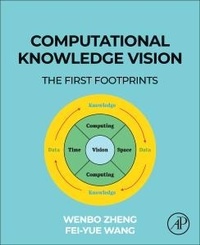
Computational Knowledge Vision
The First Footprints
Published on 22. August 2024
Book
Paperback/Softback
276 pages
978-0-443-21619-0 (ISBN)
Description
Computational Knowledge Vision: The First Footprints presents a novel, advanced framework which combines structuralized knowledge and visual models. In advanced image and visual perception studies, a visual model's understanding and reasoning ability often determines whether it works well in complex scenarios. This book presents state-of-the-art mainstream vision models for visual perception. As computer vision is one of the key gateways to artificial intelligence and a significant component of modern intelligent systems, this book delves into computer vision systems that are highly specialized and very limited in their ability to do visual reasoning and causal inference.
Questions naturally arise in this arena, including (1) How can human knowledge be incorporated with visual models? (2) How does human knowledge promote the performance of visual models? To address these problems, this book proposes a new framework for computer vision-computational knowledge vision.
Questions naturally arise in this arena, including (1) How can human knowledge be incorporated with visual models? (2) How does human knowledge promote the performance of visual models? To address these problems, this book proposes a new framework for computer vision-computational knowledge vision.
More details
Language
English
Place of publication
San Diego
United States
Publishing group
Elsevier Science Publishing Co Inc
Target group
Professional and scholarly
Product notice
Paperback (trade)
Unsewn / adhesive bound
Dimensions
Height: 229 mm
Width: 152 mm
Weight
460 gr
ISBN-13
978-0-443-21619-0 (9780443216190)
Copyright in bibliographic data and cover images is held by Nielsen Book Services Limited or by the publishers or by their respective licensors: all rights reserved.
Schweitzer Classification
Other editions
Additional editions
E-Book
08/2024
Academic Press
€175.00
Available for download
Persons
Wenbo Zheng received his bachelor degree in software engineering from Wuhan University of Technology, Wuhan, China, in 2017. He received his Ph.D. degree in computer science and technology from the Faculty of Electronic and Information Engineering, Xi'an Jiaotong University, Xi'an, China, in 2021. He is currently an Associate Professor at the School of Computer and Artificial Intelligence, Wuhan University of Technology. His research interests include computer vision and machine learning. Prof. Fei-Yue Wang is the State Specially Appointed Expert and the Founding Director of the State Key Laboratory for Management and Control of Complex Systems, Institute of Automation, Chinese Academy of Sciences, in China. He is also a research Professor at the DeSci Center of Parallel Intelligence, Obuda University, Budapest, Hungary. His research focuses on intelligent control, social computing, and knowledge automation, with a particular emphasis on energy and complex systems. He pioneered the concepts of Social Energy and the Parallel Energy initiative, aimed at integrating social intelligence into energy management and optimization. Additionally, his research explores methods and applications for parallel intelligence, social computing, and knowledge automation. He is a Fellow of INCOSE, IFAC, ASME, and AAAS. In 2007, he received the National Prize in Natural Sciences of China, numerous best papers awards from IEEE Transactions, and became an Outstanding Scientist of ACM for his work in intelligent control and social computing. In 2024, he received IEEE CRFID Emily Sopensky Meritorious Service Award, IEEE SMC Lotfi A. Zadeh Pioneer Award, and 2025 IEEE Transportation Technologies Award. In 2025, he received IEEE ITSS Lifetime Achievement Award. Additionally, in 2021, he was selected as the IFAC Pavel J. Nowacki Distinguished Lecturer.
Content
1. Introduction Computational Knowledge Vision Frameworkn
2. Reviewing the Past Enables us to Learnn
3. Computational Knowledge Vision Computational Knowledge Vision Solutionn
4. Low Vision: Computational Knowledge Vision for Edge Detection Modeln
5. Middle Vision: Computational Knowledge Vision for Visual Translation Modeln
6. Middle Vision: Computational Knowledge Vision for Jointly Face Recognitionn
7. High Vision: Computational Knowledge Vision for Visual Reasoning Model Computational Knowledge Vision Applicationn
8. Affective Computing: Computational Knowledge Vision for Depression Detection Modeln
9. Medical Computing: Computational Knowledge Vision for COVID-19 Detection Modeln
10. Medical Computing: Computational Knowledge Vision for Medical Visual Reasoning Model
2. Reviewing the Past Enables us to Learnn
3. Computational Knowledge Vision Computational Knowledge Vision Solutionn
4. Low Vision: Computational Knowledge Vision for Edge Detection Modeln
5. Middle Vision: Computational Knowledge Vision for Visual Translation Modeln
6. Middle Vision: Computational Knowledge Vision for Jointly Face Recognitionn
7. High Vision: Computational Knowledge Vision for Visual Reasoning Model Computational Knowledge Vision Applicationn
8. Affective Computing: Computational Knowledge Vision for Depression Detection Modeln
9. Medical Computing: Computational Knowledge Vision for COVID-19 Detection Modeln
10. Medical Computing: Computational Knowledge Vision for Medical Visual Reasoning Model