

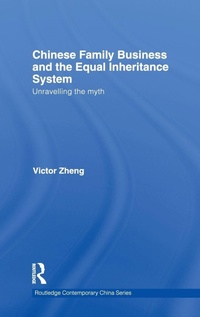
Chinese Family Business and the Equal Inheritance System
Unravelling the Myth
1st Edition
Published on 14. December 2009
Book
Hardback
222 pages
978-0-415-55638-5 (ISBN)
Description
This book disputes the traditional argument that the equal inheritance system hinders the growth of Chinese family business, approaching this not only in terms of economic capital, but also in terms of human capital such as education and leadership, and social networks.
Zheng argues that most of the family business patriarchs only focus on the passing on economic capital, but give little attention to human capital and social capital when the come to the stage to transfer control to the next level. It further elaborates that the equal inheritance system itself isn't the destructive force that weakens family business competitiveness, but can assist economic development by generating dynamism and capital.
Based on extensive primary research, the work discusses how equal division encourages sibling comparison, analysing how such comparisons initially generate stress and anxiety but will ultimately galvanize competition, benefiting the business. The author also assesses how family division can offer initial economic human and social capitals that can motivate siblings to start their own businesses and be free from the subjugation sometimes associated with a family firm. Through the evaluation of these issues the book argues that the equal inheritance system can be regarded as the origin of the self-employment mentality, which not only fosters the growth of Chinese family business by plays crucial role in promoting economic development.
Providing a valuable contribution to the field, this work will be of great interest to all scholars of Chinese and Asian business.
Zheng argues that most of the family business patriarchs only focus on the passing on economic capital, but give little attention to human capital and social capital when the come to the stage to transfer control to the next level. It further elaborates that the equal inheritance system itself isn't the destructive force that weakens family business competitiveness, but can assist economic development by generating dynamism and capital.
Based on extensive primary research, the work discusses how equal division encourages sibling comparison, analysing how such comparisons initially generate stress and anxiety but will ultimately galvanize competition, benefiting the business. The author also assesses how family division can offer initial economic human and social capitals that can motivate siblings to start their own businesses and be free from the subjugation sometimes associated with a family firm. Through the evaluation of these issues the book argues that the equal inheritance system can be regarded as the origin of the self-employment mentality, which not only fosters the growth of Chinese family business by plays crucial role in promoting economic development.
Providing a valuable contribution to the field, this work will be of great interest to all scholars of Chinese and Asian business.
More details
Series
Language
English
Place of publication
London
United Kingdom
Publishing group
Taylor & Francis Ltd
Target group
College/higher education
Product notice
Paper over boards
Illustrations
23 s/w Tabellen, 6 s/w Zeichnungen, 6 s/w Abbildungen
23 Tables, black and white; 6 Line drawings, black and white; 6 Illustrations, black and white
Dimensions
Height: 240 mm
Width: 161 mm
Thickness: 17 mm
Weight
508 gr
ISBN-13
978-0-415-55638-5 (9780415556385)
Copyright in bibliographic data and cover images is held by Nielsen Book Services Limited or by the publishers or by their respective licensors: all rights reserved.
Schweitzer Classification
Other editions
Additional editions
Book
01/2013
1st Edition
Routledge
€83.40
Shipment within 15-20 days
E-Book
12/2009
Routledge
€77.99
Available for download
E-Book
12/2009
Routledge
€77.99
Available for download
Person
Victor Zheng is currently Research Assistant Professor of the Centre of Asian Studies, HKU. His research interest includes: Chinese family business and inheritance, Hong Kong commercial history and society, social indicators and social development.
Content
1. Equal Inheritance and Family Business Continuity 2. Methodology and Sketches of the Studied Families 3. The Transfer of Economic Capital 4. The Transfer of Human Capital
5. The Transfer of Social Capital 6. Equal Inheritance and Economic Development
5. The Transfer of Social Capital 6. Equal Inheritance and Economic Development