

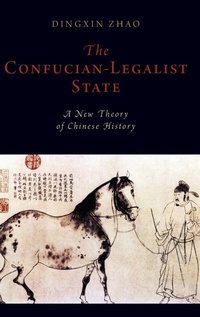
The Confucian-Legalist State
A New Theory of Chinese History
Published on 10. December 2015
Book
Hardback
472 pages
978-0-19-935173-2 (ISBN)
Description
The Confucian-Legalist State analyzes the history of China between the 11th century BCE and 1911 under the guidance of a new theory of social change. It centers on two questions. First, how and why China was unified and developed into a bureaucratic empire under the state of Qin in 221 BCE? Second, how was it that, until the nineteenth century, the political and cultural structure of China that was institutionalized during the Western Han dynasty (206 BCE - 8 CE) showed great resilience, despite great changes in demography, socioeconomic structure, ethnic composition, market relations, religious landscapes, technology, and in other respects brought by rebellions or nomadic conquests? In addressing these two questions, author Dingxin Zhao also explains numerous other historical patterns of China, including but not limited to the nature of ancient China's interstate relations, the logics behind the rising importance of imperil Confucianism during the Western Han dynasty and behind the formation of Neo-Confucian society during the Song dynasty (960-1279 CE), the changing nature of China's religious ecology under the age of Buddhism and Neo-Confucianism, the pattern of interactions between nomads and sedentary Chinese empires, the rise and dominance of civilian government, and China's inability to develop industrial capitalism without the coercion of Western imperialism.
Reviews / Votes
A surprisingly rich new macro-historical approach to Chinese civilization.... This wide-ranging work of thoughtful analysis is as refreshing as it is sound, and will repay the reading of anyone interested in understanding China. * Russell Kirkland, University of Georgia * no earlier historians of the modernization school have attempted to make their case with such a thorough discussion of all of history (with the exception of Mark Elvin, who saw a revolution on all fronts in the middle period and stagnation thereafter); have done so in a manner that casts new light on the interpretation of early history; or have taken early modern Europe as a comparative frame for all of China's history. It is a strong defense of the liberal position in China today against those scholars and politicians who claim that China's future can be positively related to its past. * Peter K. Bol, American Historical Review *More details
Other editions
Additional editions
Dingxin Zhao
The Confucian-Legalist State: A New Theory of Chinese History
A New Theory of Chinese History
Book
06/2018
Oxford University Press Inc
€67.50
Shipment within 15-20 days
E-Book
10/2015
1st Edition
OUP eBook
€31.49
Available for download
E-Book
09/2015
1st Edition
OUP eBook
€31.49
Available for download
Person
Dingxin Zhao is Professor of Sociology at the University of Chicago and the author of several books, including the award-winning Power of Tiananmen (University of Chicago Press, 2001).
Content
Preface ; A Disclaimer ; Maps ; Part I. Empirical and Theoretical Considerations ; Introduction ; Chapter 1: A Theory of Historical Change ; Part II. The Historical Background of the Eastern Zhou Dynasty ; Chapter 2: The Western Zhou (ca. 1045-771 BCE) Order and Its Decline ; Chapter 3: The Historical Setting of Eastern Zhou, an Age of War ; Part III. War-driven Dynamism in Eastern Zhou ; Chapter 4: The Age of Hegemons (770-546 BCE) ; Chapter 5: The Age of Transition (545-420 BCE) ; Chapter 6: In the Age of Total War (419-221 BCE): (1) Philosophies and ; Philosophers ; Chapter 7: In the Age of Total War: (2) Absolutism Prevailing ; Chapter 8: In the Age of Total War: (3) Qin and the Drive toward Unification ; Chapter 9: Western Han and the Advent of the Confucian-Legalist State ; Part IV. The Confucian-Legalist State and Patterns of Chinese History ; Chapter 10: Pre-Song Challenges to the Confucian-Legalist ; Political Framework and Song Responses ; Chapter 11: Relations between Nomads and Settled Chinese in History ; Chapter 12: Neo-Confucianism and the Advent of a <"Confucian Society>" ; Chapter 13: Market Economy under the Confucian-Legalist State ; Concluding Remarks ; References