

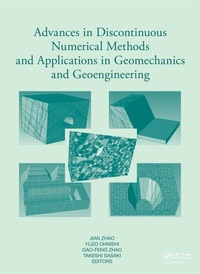
Advances in Discontinuous Numerical Methods and Applications in Geomechanics and Geoengineering
Published on 27. January 2012
Book
Hardback
440 pages
978-0-415-68404-0 (ISBN)
Description
Rocks and soils can behave as discontinuous materials, both physically and mechanically, and for such discontinuous nature and behaviour there remain challenges in numerical modelling methods and techniques. Some of the main discontinuum based numerical methods, for example the distinct element method (DEM) and the discontinuous deformation analysis (DDA), are associated with geomechanics and geoengineering. Discontinuous numerical methods have been widely applied in geoengineering related to civil, mining, hydropower and petroleum engineering. There are many good examples of the use of UDEC/3DEC and DDA in design and forensic of geoengineering projects, in dams, slopes, tunnels, caverns and mines. The discontinuous numerical methods provide good tools to capture the true physical and mechanical behaviours of the geomaterials, and provide the scientific insights enabling for better engineering. Discontinuous numerical methods are indeed very much research and engineering tools of the present, and certainly more in the future.
Advances in Discontinuous Numerical Methods and Applications in Geomechanics and Geoengineering is a collection of 55 technical papers presented at the 10th International Conference on Analysis of Discontinuous Deformation (ICADD-10), held 6-8 December 2011, Honolulu, USA. The papers cover a wide scope of discontinuous numerical methods from algorithms and mechanics, to modelling techniques and applications, including the key block theory, the discontinuous deformation analysis, the numerical manifold method, the distinct element method, coupled discontinuum and continuum methods, multi-scale and multi-physics in modelling, applications and case studies of engineering projects.
Advances in Discontinuous Numerical Methods and Applications in Geomechanics and Geoengineering is a collection of 55 technical papers presented at the 10th International Conference on Analysis of Discontinuous Deformation (ICADD-10), held 6-8 December 2011, Honolulu, USA. The papers cover a wide scope of discontinuous numerical methods from algorithms and mechanics, to modelling techniques and applications, including the key block theory, the discontinuous deformation analysis, the numerical manifold method, the distinct element method, coupled discontinuum and continuum methods, multi-scale and multi-physics in modelling, applications and case studies of engineering projects.
More details
Language
English
Place of publication
London
United Kingdom
Publishing group
Taylor & Francis Ltd
Target group
College/higher education
Professional and scholarly
Postgraduate and Professional
Dimensions
Height: 246 mm
Width: 174 mm
Weight
960 gr
ISBN-13
978-0-415-68404-0 (9780415684040)
Copyright in bibliographic data and cover images is held by Nielsen Book Services Limited or by the publishers or by their respective licensors: all rights reserved.
Schweitzer Classification
Other editions
Additional editions
Jian Zhao | Yuzo Ohnishi | Gao-Feng Zhao
Advances in Discontinuous Numerical Methods and Applications in Geomechanics and Geoengineering
E-Book
01/2012
1st Edition
CRC Press
€238.99
Available for download
Jian Zhao | Yuzo Ohnishi | Gao-Feng Zhao
Advances in Discontinuous Numerical Methods and Applications in Geomechanics and Geoengineering
E-Book
01/2012
1st Edition
CRC Press
€238.99
Available for download
Persons
Jian Zhao, Yuzo Ohnishi, Gao-Feng Zhao, Takeshi Sasaki
Content
Keynotes
Discontinuous deformation analysis method and applications
Key block theory, block cutting and applications
Numerical manifold method and further developments
Distinct element method and applications
Discontinuous modelling of finite element and other methods
Discontinuous deformation analysis method and applications
Key block theory, block cutting and applications
Numerical manifold method and further developments
Distinct element method and applications
Discontinuous modelling of finite element and other methods