

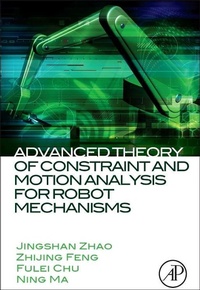
Advanced Theory of Constraint and Motion Analysis for Robot Mechanisms
Published on 4. December 2013
Book
Hardback
496 pages
978-0-12-420162-0 (ISBN)
Description
Advanced Theory of Constraint and Motion Analysis for Robot Mechanisms provides a complete analytical approach to the invention of new robot mechanisms and the analysis of existing designs based on a unified mathematical description of the kinematic and geometric constraints of mechanisms.
Beginning with a high level introduction to mechanisms and components, the book moves on to present a new analytical theory of terminal constraints for use in the development of new spatial mechanisms and structures. It clearly describes the application of screw theory to kinematic problems and provides tools that students, engineers and researchers can use for investigation of critical factors such as workspace, dexterity and singularity.
Beginning with a high level introduction to mechanisms and components, the book moves on to present a new analytical theory of terminal constraints for use in the development of new spatial mechanisms and structures. It clearly describes the application of screw theory to kinematic problems and provides tools that students, engineers and researchers can use for investigation of critical factors such as workspace, dexterity and singularity.
More details
Language
English
Place of publication
San Diego
United States
Publishing group
Elsevier Science Publishing Co Inc
Target group
Professional and scholarly
Researchers, engineers and graduate students working on engineering design, robotics and automation.
Product notice
sewn/stitched
Paper over boards
Illustrations
Approx. 120 illustrations
Dimensions
Height: 236 mm
Width: 156 mm
Thickness: 27 mm
Weight
933 gr
ISBN-13
978-0-12-420162-0 (9780124201620)
Copyright in bibliographic data and cover images is held by Nielsen Book Services Limited or by the publishers or by their respective licensors: all rights reserved.
Schweitzer Classification
Other editions
Additional editions

Jingshan Zhao | Zhijing Feng | Fulei Chu
Advanced Theory of Constraint and Motion Analysis for Robot Mechanisms
Book
10/2018
Academic Press
€154.75
The article will not be published
Jingshan Zhao | Zhijing Feng | Fulei Chu
Advanced Theory of Constraint and Motion Analysis for Robot Mechanisms
E-Book
11/2013
Academic Press
€155.00
Available for download
Persons
Jingshan Zhao is a leading machine design, mechanical systems and robotics researcher at China's prestigious Tsinghua University. He has received numerous awards for doctoral excellence in China over the past decade, including the New Century Excellent Talents in University Award in 2009 from the Education Ministry of China. He has contributed to more than 40 articles in international journals, is an editorial board member of the Journal of Machinery and Automation, and is the regional editor for Asia of The Open Mechanical Engineering Journal.
Content
Chapter 1: Introduction (Mechanisms and Components)Chapter 2: Primary Theory of Reciprocal ScrewsChapter 3: Twists and Wrenches of a Kinematic ChainChapter 4: Free Motion of the End-Effector of a Robotic MechanismChapter 5: Workspace of the End-Effector of a Robotic MechanismChapter 6: Singularity Analysis of the End-Effector of a Mechanism within Its WorkspaceChapter 7: Kinematics with Four Point Cartesian Coordinates for Spatial Parallel ManipulatorChapter 8: Kinematics and Statics of Robot MechanismsChapter 9: The Motion Characteristics of a Robot Mechanism within its WorkspaceChapter 10: Fundamental Factors to Investigating the Motions and Actuations of a MechanismChapter 11: The Mechanism Theory and Application of Deployable Structures Based on SLEChapter 12: Structure Synthesis of Spatial MechanismsChapter 13: Workspace Synthesis of Spatial MechanismsChapter 14: Kinematic Synthesis of Spatial Mechanisms