

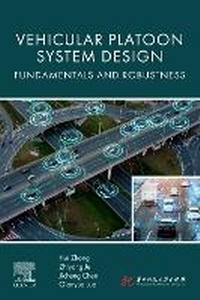
Vehicular Platoon System Design
Fundamentals and Robustness
Published on 19. August 2024
Book
Paperback/Softback
314 pages
978-0-443-29857-8 (ISBN)
Description
Vehicular Platoon System Design: Fundamentals and Robustness provides a comprehensive introduction to connected and automated vehicular platoon system design. Platoons decrease the distances between cars or trucks using electronic, and possibly mechanical, coupling. This capability allows many cars or trucks to accelerate or brake simultaneously. It also allows for a closer headway between vehicles by eliminating reacting distance needed for human reaction. The book considers the key issues of robustness and cybersecurity, with optimization-based model predictive control schemes applied to control vehicle platoon.
In the controller design part, several practical problems, such as constraint handling, optimal control performance, robustness against disturbance, and resilience against cyberattacks are reviewed. In addition, the book provides detailed theoretical analysis of the stability of the platoon under different control schemes.
In the controller design part, several practical problems, such as constraint handling, optimal control performance, robustness against disturbance, and resilience against cyberattacks are reviewed. In addition, the book provides detailed theoretical analysis of the stability of the platoon under different control schemes.
More details
Language
English
Place of publication
Philadelphia
United States
Target group
Professional and scholarly
Product notice
Paperback (trade)
Unsewn / adhesive bound
Dimensions
Height: 229 mm
Width: 152 mm
Thickness: 17 mm
Weight
422 gr
ISBN-13
978-0-443-29857-8 (9780443298578)
Copyright in bibliographic data and cover images is held by Nielsen Book Services Limited or by the publishers or by their respective licensors: all rights reserved.
Schweitzer Classification
Other editions
Additional editions
E-Book
08/2024
Elsevier
€186.99
Available for download
Persons
Professor Zhang received his PhD degree in Mechanical Engineering from the University of Victoria, Canada and undertook three years of postdoctoral work at The Ohio State University, USA. He has published more than 70 peer-reviewed journal papers. Moreover, he has successfully organized 5 special issues for Mechanical Systems and Signal
Processing, Journal of The Franklin Institute, International Journal of Vehicle Design, IEEE Access, and Mechatronics.
Dr. Ju graduated from the University of Melbourne, Australia in 2019 and was a postdoctoral researcher from 2019 to 2022 at Beihang University, China. He is now an associate professor with the Beijing Institute of Technology. His research interests include cybersecurity of cyber-physical systems, multiagent systems, vehicle dynamics and control, and autonomous vehicles. He has published 10 SCI papers in vehicle platooning control and vehicle attack detection. He serves as reviewers for various international journals such as IEEE TIV, TVT, TIE.
Dr. Chen graduated from the University of Victoria, Canada, in 2021 and he is currently a postdoctoral researcher in Beihang University, China. He has published 20 SCI and EI indexed papers in the field of control theory, vehicle dynamics control, cybersecurity, and autonomous vehicles.
Qianyue Luo's research interest includes heterogeneous vehicles dynamics modelling and connected vehicle control.
Processing, Journal of The Franklin Institute, International Journal of Vehicle Design, IEEE Access, and Mechatronics.
Dr. Ju graduated from the University of Melbourne, Australia in 2019 and was a postdoctoral researcher from 2019 to 2022 at Beihang University, China. He is now an associate professor with the Beijing Institute of Technology. His research interests include cybersecurity of cyber-physical systems, multiagent systems, vehicle dynamics and control, and autonomous vehicles. He has published 10 SCI papers in vehicle platooning control and vehicle attack detection. He serves as reviewers for various international journals such as IEEE TIV, TVT, TIE.
Dr. Chen graduated from the University of Victoria, Canada, in 2021 and he is currently a postdoctoral researcher in Beihang University, China. He has published 20 SCI and EI indexed papers in the field of control theory, vehicle dynamics control, cybersecurity, and autonomous vehicles.
Qianyue Luo's research interest includes heterogeneous vehicles dynamics modelling and connected vehicle control.
Content
1. Introduction
2. Fundamentals in MPC-based Platoon Control
3. Robust Tube-based DMPC Platoon Control Design
4. Stochastic Tube-based DMPC Platoon Control Design
5. Attack Detection using UFIR Estimator
6. Distributed Deception Attack Detection
7. Attack Detection using Moving Horizon Estimation
8. Event-triggered Resilient Platoon Control
9.Conclusions and future research work
2. Fundamentals in MPC-based Platoon Control
3. Robust Tube-based DMPC Platoon Control Design
4. Stochastic Tube-based DMPC Platoon Control Design
5. Attack Detection using UFIR Estimator
6. Distributed Deception Attack Detection
7. Attack Detection using Moving Horizon Estimation
8. Event-triggered Resilient Platoon Control
9.Conclusions and future research work