

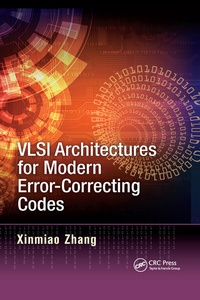
VLSI Architectures for Modern Error-Correcting Codes
1st Edition
Published on 18. December 2020
Book
Paperback/Softback
410 pages
978-0-367-73803-7 (ISBN)
Description
Error-correcting codes are ubiquitous. They are adopted in almost every modern digital communication and storage system, such as wireless communications, optical communications, Flash memories, computer hard drives, sensor networks, and deep-space probing. New-generation and emerging applications demand codes with better error-correcting capability. On the other hand, the design and implementation of those high-gain error-correcting codes pose many challenges. They usually involve complex mathematical computations, and mapping them directly to hardware often leads to very high complexity.
VLSI Architectures for Modern Error-Correcting Codes serves as a bridge connecting advancements in coding theory to practical hardware implementations. Instead of focusing on circuit-level design techniques, the book highlights integrated algorithmic and architectural transformations that lead to great improvements on throughput, silicon area requirement, and/or power consumption in the hardware implementation.
The goal of this book is to provide a comprehensive and systematic review of available techniques and architectures, so that they can be easily followed by system and hardware designers to develop en/decoder implementations that meet error-correcting performance and cost requirements. This book can be also used as a reference for graduate-level courses on VLSI design and error-correcting coding. Particular emphases are placed on hard- and soft-decision Reed-Solomon (RS) and Bose-Chaudhuri-Hocquenghem (BCH) codes, and binary and non-binary low-density parity-check (LDPC) codes. These codes are among the best candidates for modern and emerging applications due to their good error-correcting performance and lower implementation complexity compared to other codes. To help explain the computations and en/decoder architectures, many examples and case studies are included.
More importantly, discussions are provided on the advantages and drawbacks of different implementation approaches and architectures.
VLSI Architectures for Modern Error-Correcting Codes serves as a bridge connecting advancements in coding theory to practical hardware implementations. Instead of focusing on circuit-level design techniques, the book highlights integrated algorithmic and architectural transformations that lead to great improvements on throughput, silicon area requirement, and/or power consumption in the hardware implementation.
The goal of this book is to provide a comprehensive and systematic review of available techniques and architectures, so that they can be easily followed by system and hardware designers to develop en/decoder implementations that meet error-correcting performance and cost requirements. This book can be also used as a reference for graduate-level courses on VLSI design and error-correcting coding. Particular emphases are placed on hard- and soft-decision Reed-Solomon (RS) and Bose-Chaudhuri-Hocquenghem (BCH) codes, and binary and non-binary low-density parity-check (LDPC) codes. These codes are among the best candidates for modern and emerging applications due to their good error-correcting performance and lower implementation complexity compared to other codes. To help explain the computations and en/decoder architectures, many examples and case studies are included.
More importantly, discussions are provided on the advantages and drawbacks of different implementation approaches and architectures.
Reviews / Votes
"Error-correction coding has become an ineluctable feature for the development of modern telecommunication and storage systems. The VLSI implementation of powerful error-correcting codes and decoders with a minimum hardware resource is especially of great importance for the integration of the codes in high-speed, low consumption circuits. Such implementation requires a deep understanding of both mathematical theory of the codes and VLSI architecture design of their decoders, a dual expertise that Dr. Xinmiao Zhang was able to transcribe with high rigor and clarity in this book. From cyclic codes to the more recent binary and non-binary LDPC codes, this book equips any engineer or researcher with the necessary knowledge to implement state-of-the-art solutions."-Prof. David Declercq, Director General of Research at the ENSEA, Cergy-Pontoise, France"This book is unique in its synthesis of the advanced concepts in abstract algebra, decoding algorithms and architecture used masterfully to introduce VLSI implementations of highly sophisticated decoders of modern error correction codes."
-Bane Vasic, University of Arizona "Error-correction coding has become an ineluctable feature for the development of modern telecommunication and storage systems. The VLSI implementation of powerful error-correcting codes and decoders with a minimum hardware resource is especially of great importance for the integration of the codes in high-speed, low consumption circuits. Such implementation requires a deep understanding of both mathematical theory of the codes and VLSI architecture design of their decoders, a dual expertise that Dr. Xinmiao Zhang was able to transcribe with high rigor and clarity in this book. From cyclic codes to the more recent binary and non-binary LDPC codes, this book equips any engineer or researcher with the necessary knowledge to implement state-of-the-art solutions."-Prof. David Declercq, Director General of Research at the ENSEA, Cergy-Pontoise, France
"This book is unique in its synthesis of the advanced concepts in abstract algebra, decoding algorithms and architecture used masterfully to introduce VLSI implementations of highly sophisticated decoders of modern error correction codes."
-Bane Vasic, University of Arizona
More details
Language
English
Place of publication
London
United Kingdom
Publishing group
Taylor & Francis Ltd
Target group
College/higher education
Dimensions
Height: 234 mm
Width: 156 mm
Weight
453 gr
ISBN-13
978-0-367-73803-7 (9780367738037)
Copyright in bibliographic data and cover images is held by Nielsen Book Services Limited or by the publishers or by their respective licensors: all rights reserved.
Schweitzer Classification
Other editions
Additional editions
Xinmiao Zhang
VLSI Architectures for Modern Error-Correcting Codes
E-Book
12/2017
CRC Press
€80.49
Available for download
Xinmiao Zhang
VLSI Architectures for Modern Error-Correcting Codes
E-Book
12/2017
CRC Press
€80.49
Available for download
Xinmiao Zhang
VLSI Architectures for Modern Error-Correcting Codes
Book
07/2015
1st Edition
CRC Press
€245.53
Article not available for order
Person
Xinmiao Zhang received her Ph.D in electrical engineering from the University of Minnesota, Twin Cities, USA. She is currently an Associate Professor in the Department of Electrical and Computer Engineering at The Ohio State University. Previously, she was a Timothy E. and Allison L. Schroeder Associate Professor at Case Western Reserve University, Cleveland, Ohio. Between her academic positions, she continued her research on error-correcting codes at SanDisk/Western Digital Corporation. She has also been a visiting professor at Qualcomm and spent her sabbatical leave at the University of Washington, Seattle, USA. Her research focuses on VLSI architecture design for communications, digital signal processing, and cryptography. She is a recipient of the National Science Foundation Faculty Early Career Development (CAREER) Award.
Content
Finite Field Arithmetic. VLSI Architecture Design Fundamentals. Root Computations for Polynomials Over Finite Fields. Reed-Solomon Encoder and Hard-Decision Decoder Architectures. Algebraic Soft-Decision Reed-Solomon Decoder Architectures. Interpolation-Based Chase and Generalized Minimum Distance Decoders. BCH Encoder and Decoder Architectures. Binary LDPC Codes and Decoder Architectures. Non-Binary LDPC Decoder Architectures.