

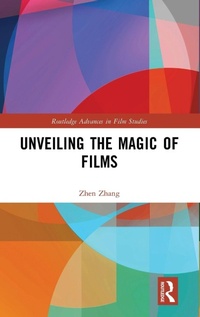
Unveiling the Magic of Films
1st Edition
Published on 31. October 2025
Book
Hardback
310 pages
978-1-032-71167-6 (ISBN)
Description
This book presents a comprehensive methodology for segmenting, transcribing, and analysing feature films, especially classical Hollywood films. It offers an in-depth study of three scenes from Roman Holiday (1953), each showcasing different combinations of verbal and non-verbal performance.
Through detailed study, this book demonstrates how Roman Holiday can be broken down into Episodes, Events, Facts, Tasks, and Actions, while also exploring the semiotic modes involved in acting, art direction, cinematography, and editing. It reveals how acting constructs characters, relationships, situations, and the story's generic structure, and examines how art direction, cinematography, and editing contribute to both performance and genre development. Building on these investigations, the book hypothesises performance features. These hypothesised features are subsequently tested on the Chinese film Raise the Red Lantern (1991), showcasing their flexibility and potential for broader application in film performance.
The book makes a significant contribution to existing research by bridging film performance theories with social semiotics, synthesising them into a cohesive framework that is applicable to both Hollywood and non-Hollywood films. This book is especially valuable for scholars, practitioners, and students of film studies and social semiotics.
Through detailed study, this book demonstrates how Roman Holiday can be broken down into Episodes, Events, Facts, Tasks, and Actions, while also exploring the semiotic modes involved in acting, art direction, cinematography, and editing. It reveals how acting constructs characters, relationships, situations, and the story's generic structure, and examines how art direction, cinematography, and editing contribute to both performance and genre development. Building on these investigations, the book hypothesises performance features. These hypothesised features are subsequently tested on the Chinese film Raise the Red Lantern (1991), showcasing their flexibility and potential for broader application in film performance.
The book makes a significant contribution to existing research by bridging film performance theories with social semiotics, synthesising them into a cohesive framework that is applicable to both Hollywood and non-Hollywood films. This book is especially valuable for scholars, practitioners, and students of film studies and social semiotics.
More details
Series
Language
English
Place of publication
London
United Kingdom
Publishing group
Taylor & Francis Ltd
Target group
Professional and scholarly
Academic
Illustrations
18 s/w Abbildungen, 2 s/w Photographien bzw. Rasterbilder, 16 s/w Zeichnungen, 95 s/w Tabellen
95 Tables, black and white; 16 Line drawings, black and white; 2 Halftones, black and white; 18 Illustrations, black and white
Dimensions
Height: 240 mm
Width: 161 mm
Thickness: 22 mm
Weight
649 gr
ISBN-13
978-1-032-71167-6 (9781032711676)
Copyright in bibliographic data and cover images is held by Nielsen Book Services Limited or by the publishers or by their respective licensors: all rights reserved.
Schweitzer Classification
Other editions
Additional editions
Zhen Zhang
Unveiling the Magic of Films
E-Book
10/2025
1st Edition
Routledge
€60.49
Available for download
Zhen Zhang
Unveiling the Magic of Films
E-Book
10/2025
1st Edition
Routledge
€60.49
Available for download
Person
Zhen Zhang is an academic at the University of Sydney. Her interdisciplinary research spans film studies, digital culture, social semiotics, etc.
Content
1. Introduction; 2. Theoretical Foundations; 3. Methodology for Film Performance Segmentation, Transcription, and Analysis; 4. The Dialogue-Based Scene-Segmentation Methods, Performance Patterns, and Genre Constructions; 5. The Dialogue- and Gesture-Based Scene-Segmentation Methods, Performance Patterns, and Genre Constructions; 6. The Gesture-Based Scene-Segmentation Methods, Performance Patterns, and Genre Constructions; 7. Conclusion; Appendices