

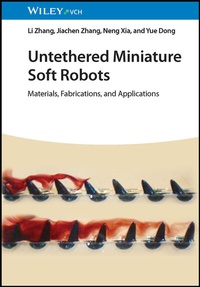
Untethered Miniature Soft Robots
Materials, Fabrications, and Applications
1st Edition
Published on 29. November 2023
Book
Hardback
256 pages
978-3-527-35177-0 (ISBN)
Description
Covers the latest achievements in smart materials, fabrication strategies, and the multifunctional intelligent robots.
More details
Edition
1. Auflage
Language
English
Place of publication
Berlin
Germany
Target group
Professional and scholarly
Illustrations
125
3 s/w Abbildungen, 122 farbige Abbildungen
Dimensions
Height: 24.4 cm
Width: 17 cm
Thickness: 1.9 cm
Weight
646 gr
ISBN-13
978-3-527-35177-0 (9783527351770)
Schweitzer Classification
Other editions
Additional editions
Li Zhang | Jiachen Zhang | Neng Xia
Untethered Miniature Soft Robots
Materials, Fabrications, and Applications
E-Book
10/2023
1st Edition
Wiley-VCH
€129.99
Available for download
Persons
Li Zhang is Professor in the Department of Mechanical and Automation Engineering (MAE) and Professor by Courtesy in the Department of Surgery at The Chinese University of Hong Kong (CUHK). He is also a director of the Shenzhen Institutes of Advanced Technology (SIAT) of the Chinese Academy of Sciences (CAS)-CUHK Joint Laboratory of Robotics and Intelligent Systems. Before he joined CUHK as Assistant Professor in 2012, he worked in Prof. Bradley Nelson's group as a postdoc and then as a senior scientist and lecturer in the Institute of Robotics and Intelligent Systems (IRIS), Swiss Federal Institute of Technology (ETH) Zurich, Switzerland. Dr. Zhang's main research interests include small-scale robotics and their applications for translational biomedicine.
Jiachen Zhang is Assistant Professor in the Department of Biomedical Engineering at City University of Hong Kong (CityU). Before he joined CityU in 2021, he worked in Prof. Metin Sitti?s group as a postdoc and simultaneously a Humboldt postdoc fellow in the Physical Intelligence department at Max Planck Institute of Intelligent Systems (MPI-IS), Germany. Dr. Zhang?s main research interests include magnetically controlled miniature soft-bodied robots and their biomedical applications.
Neng Xia received the B. Eng. degree from Central South University, Changsha, China, and the M. S. degree from Zhejiang University, Hangzhou, China, in 2016 and 2019, respectively, both in mechanical engineering. He is currently a Ph.D. candidate in The Chinese University of Hong Kong. His research focuses on magnetic soft robots, hydrogel materials, and 3D printing.
Yue Dong received his Ph.D. degree in 2019 from the College of Life Science and Technology, Huazhong University of Science and Technology, China. He worked as a postdoctoral fellow in the Department of Mechanical and Automation Engineering from July 2019 to the present, The Chinese University of Hong Kong. His research interests include programmable actuators, soft magnetic robots, robot swarm, graphene assembly, and microfluidic.
Jiachen Zhang is Assistant Professor in the Department of Biomedical Engineering at City University of Hong Kong (CityU). Before he joined CityU in 2021, he worked in Prof. Metin Sitti?s group as a postdoc and simultaneously a Humboldt postdoc fellow in the Physical Intelligence department at Max Planck Institute of Intelligent Systems (MPI-IS), Germany. Dr. Zhang?s main research interests include magnetically controlled miniature soft-bodied robots and their biomedical applications.
Neng Xia received the B. Eng. degree from Central South University, Changsha, China, and the M. S. degree from Zhejiang University, Hangzhou, China, in 2016 and 2019, respectively, both in mechanical engineering. He is currently a Ph.D. candidate in The Chinese University of Hong Kong. His research focuses on magnetic soft robots, hydrogel materials, and 3D printing.
Yue Dong received his Ph.D. degree in 2019 from the College of Life Science and Technology, Huazhong University of Science and Technology, China. He worked as a postdoctoral fellow in the Department of Mechanical and Automation Engineering from July 2019 to the present, The Chinese University of Hong Kong. His research interests include programmable actuators, soft magnetic robots, robot swarm, graphene assembly, and microfluidic.
Content
Preface
INTRODUCTION TO UNTETHERED MINIATURE SOFT ROBOTS
Working Mechanisms of Untethered Soft Robots
Fabrication Methods of Untethered Soft Robots
Applications of Miniature Soft Robots
Scope and Layout of the Book
SILICONE ELASTOMER BASED MINIATURE SOFT ROBOTS
Introduction
Soft Elastomer Based Robots with Programmable Magnetization Profiles
Reprogrammable Soft Machines
Multi-Stimuli Responsive Transformation of Magneto-Elastomer Based Soft Structures
Multimodal and Bioinspired Locomotion Adopted for Elastomer Based Robots
Potential Biomedical Applications of Miniature Magnetic Soft Machines
Fluidic Pumping by the Magneto-Elastomers
Other Potential Applications of the Magneto-Elastomers
Summary
CARBON-BASED MINIATURE SOFT ROBOTS WITH ROLLED-UP CONCEPT
Introduction
The Choices of Carbon-Based Materials
The Working Mechanisms of Carbon-Based Materials
The Programming Shape Changes of Actuators and their Applications
Summary
HYDROGELS-BASED MINIATURE SOFT ROBOTS
Introduction
Fabrication of Reconfigurable Hydrogel Micromachines
Modular Design of Reconfigurable Soft Robots based on 4D Microscale Building Blocks
Application of Reconfigurable Soft Robots
Summary
LIQUID CRYSTAL NETWORK AND ELASTOMER-BASED MINIATURE SOFT ROBOTS
Introduction
Stimuli-Responsiveness based on Programmed Director Field
Magnetic Liquid Elastomer Composites for Miniature Machines
Summary
FLEXIBLE FERROFLUID AS SOFT ROBOTS AGENTS
Introduction
Description of Ferrofluids
Deformation Behaviors of FDRs
Applications of FDRs
Summary
CONCLUSIONS AND FUTURE PROSPECTS
Other Functional Materials used for Miniature Soft Robots
Multi-Material Integration Strategies
Multifunctional Integration for Miniature Soft Robots with Perception Capabilities
Perspectives toward Intelligent and Autonomous Soft Robots
INTRODUCTION TO UNTETHERED MINIATURE SOFT ROBOTS
Working Mechanisms of Untethered Soft Robots
Fabrication Methods of Untethered Soft Robots
Applications of Miniature Soft Robots
Scope and Layout of the Book
SILICONE ELASTOMER BASED MINIATURE SOFT ROBOTS
Introduction
Soft Elastomer Based Robots with Programmable Magnetization Profiles
Reprogrammable Soft Machines
Multi-Stimuli Responsive Transformation of Magneto-Elastomer Based Soft Structures
Multimodal and Bioinspired Locomotion Adopted for Elastomer Based Robots
Potential Biomedical Applications of Miniature Magnetic Soft Machines
Fluidic Pumping by the Magneto-Elastomers
Other Potential Applications of the Magneto-Elastomers
Summary
CARBON-BASED MINIATURE SOFT ROBOTS WITH ROLLED-UP CONCEPT
Introduction
The Choices of Carbon-Based Materials
The Working Mechanisms of Carbon-Based Materials
The Programming Shape Changes of Actuators and their Applications
Summary
HYDROGELS-BASED MINIATURE SOFT ROBOTS
Introduction
Fabrication of Reconfigurable Hydrogel Micromachines
Modular Design of Reconfigurable Soft Robots based on 4D Microscale Building Blocks
Application of Reconfigurable Soft Robots
Summary
LIQUID CRYSTAL NETWORK AND ELASTOMER-BASED MINIATURE SOFT ROBOTS
Introduction
Stimuli-Responsiveness based on Programmed Director Field
Magnetic Liquid Elastomer Composites for Miniature Machines
Summary
FLEXIBLE FERROFLUID AS SOFT ROBOTS AGENTS
Introduction
Description of Ferrofluids
Deformation Behaviors of FDRs
Applications of FDRs
Summary
CONCLUSIONS AND FUTURE PROSPECTS
Other Functional Materials used for Miniature Soft Robots
Multi-Material Integration Strategies
Multifunctional Integration for Miniature Soft Robots with Perception Capabilities
Perspectives toward Intelligent and Autonomous Soft Robots