

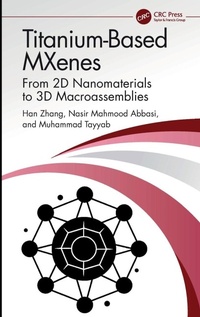
Titanium-Based MXenes
From 2D Nanomaterials to 3D Macroassemblies
1st Edition
Published on 29. June 2025
Book
Hardback
434 pages
978-1-032-31735-9 (ISBN)
Description
This book explores titanium-based MXenes, an emergent class of materials with a broad range of properties and potential applications. It introduces 3D MXene assemblies and compares their properties with such other well-known two-dimensional materials as graphene and transition metal dichalcogenides.
Features:
Focuses on emerging 2D titanium-based MXene (Ti3C2Tx and Ti2CTx) materials
Offers detailed synthetic strategies and scalable approaches
Covers defect engineering and physical properties
Compares the uniqueness of 2D titanium-based MXene with other 2D-layered materials
Discusses 3D macrostructure of titanium-based MXenes and their practical application in photodetectors, catalysis energy storage devices, and biomedicines
The first comprehensive book on the subject, this work is aimed at researchers in materials and electrical engineering and related disciplines.
Features:
Focuses on emerging 2D titanium-based MXene (Ti3C2Tx and Ti2CTx) materials
Offers detailed synthetic strategies and scalable approaches
Covers defect engineering and physical properties
Compares the uniqueness of 2D titanium-based MXene with other 2D-layered materials
Discusses 3D macrostructure of titanium-based MXenes and their practical application in photodetectors, catalysis energy storage devices, and biomedicines
The first comprehensive book on the subject, this work is aimed at researchers in materials and electrical engineering and related disciplines.
More details
Language
English
Place of publication
London
United Kingdom
Publishing group
Taylor & Francis Ltd
Target group
Professional and scholarly
College/higher education
Professional Practice & Development
Illustrations
115 s/w Abbildungen, 115 s/w Zeichnungen, 4 s/w Tabellen
4 Tables, black and white; 115 Line drawings, black and white; 115 Illustrations, black and white
Dimensions
Height: 240 mm
Width: 161 mm
Thickness: 29 mm
Weight
834 gr
ISBN-13
978-1-032-31735-9 (9781032317359)
Copyright in bibliographic data and cover images is held by Nielsen Book Services Limited or by the publishers or by their respective licensors: all rights reserved.
Schweitzer Classification
Other editions
Additional editions
Han Zhang | Nasir Mahmood Abbasi | Muhammad Tayyab
Titanium-Based MXenes
From 2D Nanomaterials to 3D Macroassemblies
E-Book
06/2025
1st Edition
CRC Press
€73.99
Available for download
Han Zhang | Nasir Mahmood Abbasi | Muhammad Tayyab
Titanium-Based MXenes
From 2D Nanomaterials to 3D Macroassemblies
E-Book
06/2025
1st Edition
CRC Press
€73.99
Available for download
Persons
Han Zhang received his B.S. degree from Wuhan University in 2006 and Ph.D. from Nanyang Technological University in 2010. He is currently working as a distinguished Professor and Director College of Physics and Optoelectronic Engineering Shenzhen University, Shenzhen 518060, China. His current research is on the ultrafast and nonlinear photonics of two-dimensional materials. He is currently the director of Shenzhen Key Laboratory of 2D Materials and Devices and Shenzhen Engineering Laboratory of Phosphorene and Optoelectronics, Shenzhen University.
Nasir Mahmood Abbasi received his master's degree in Chemistry from the University of Karachi, Pakistan, and PhD in Chemical Engineering with a focus in nanoscale materials (morphology and self-assembly of nanomaterial) from Zhejiang University, China in 2016. He worked as a postdoc fellow in the School of Physics and Optoelectronic Engineering at Shenzhen University from June 2019 to August 2021. After that worked as a scientist on a collaborative project in the Nanjing University Biomedical Engineering Department (Butch/Wang research group: https://butchresearch.com) and Research and Development unit of Nanjing Nuoyuan Medical Devices Company (October 2021 to October 2024). His research interests include heterostructures and the macroassemblies of nanoscale materials for their applications in energy, healthcare, and electronics.
Muhammad Tayyab obtained his Ph.D. in Material Science and Engineering with a specialization in Magnetic Optoelectronic Materials from Nanjing Tech University,China in 2021, has continued to expand his research pursuits. After serving as a postdoctoral researcher from October 2023 to September 2025 at Nanjing Tech University, he has extended his expertise to Shenzhen University, China, where he currently holds a postdoctoral position. With a comprehensive background in energy generation, particularly focusing on triboelectric nanogenerators (TENGs) and piezoelectric nanogenerators (PENGs), and batteries as well as diverse interests encompassing sensors and actuators, optoelectronics,flexible electronics, and capacitors, Dr. Tayyab's contributions continue to drive advancements in sustainable energy solutions and advanced materials science. His dual postdoctoral experiences underscore his commitment to interdisciplinary research and collaborative exploration in academia.
Nasir Mahmood Abbasi received his master's degree in Chemistry from the University of Karachi, Pakistan, and PhD in Chemical Engineering with a focus in nanoscale materials (morphology and self-assembly of nanomaterial) from Zhejiang University, China in 2016. He worked as a postdoc fellow in the School of Physics and Optoelectronic Engineering at Shenzhen University from June 2019 to August 2021. After that worked as a scientist on a collaborative project in the Nanjing University Biomedical Engineering Department (Butch/Wang research group: https://butchresearch.com) and Research and Development unit of Nanjing Nuoyuan Medical Devices Company (October 2021 to October 2024). His research interests include heterostructures and the macroassemblies of nanoscale materials for their applications in energy, healthcare, and electronics.
Muhammad Tayyab obtained his Ph.D. in Material Science and Engineering with a specialization in Magnetic Optoelectronic Materials from Nanjing Tech University,China in 2021, has continued to expand his research pursuits. After serving as a postdoctoral researcher from October 2023 to September 2025 at Nanjing Tech University, he has extended his expertise to Shenzhen University, China, where he currently holds a postdoctoral position. With a comprehensive background in energy generation, particularly focusing on triboelectric nanogenerators (TENGs) and piezoelectric nanogenerators (PENGs), and batteries as well as diverse interests encompassing sensors and actuators, optoelectronics,flexible electronics, and capacitors, Dr. Tayyab's contributions continue to drive advancements in sustainable energy solutions and advanced materials science. His dual postdoctoral experiences underscore his commitment to interdisciplinary research and collaborative exploration in academia.
Content
Chapter 1 An Overview of 2D Titanium-Based MXenes
Chapter 2 Morphological Engineering of 2D Titanium-Based MXene
Chapter 3 Defect Engineering/Physical Properties of Titanium-Based MXene
Chapter 4 Application of Titanium-Based MXenes in Sensing, Photovoltaics, Catalysis, Energy Storage Devices, and Biomedicines
Chapter 5 Composite Structures of 2D Titanium-Based MXenes with Polymers
Chapter 6 Mixed-Dimensional Heterostructures of Titanium-Based MXene with other 2D Layered Materials
Chapter 7 Mixed-Dimensional Titanium-Based MXene Heterostructures in Supercapacitors and Batteries-Based Energy Storage Network
Chapter 8 Mixed-Dimensional Titanium-Based Structures in Photovoltaics and Catalysis
Chapter 9 Preparation of 3D Assemblies/Structures of Titanium-Based MXenes
Chapter 10 Application of 3D Assemblies/Structures of Titanium-Based MXenes in Sensing, Photovoltaics, and Catalysis
Chapter 11 Summary and Future Directions
Chapter 2 Morphological Engineering of 2D Titanium-Based MXene
Chapter 3 Defect Engineering/Physical Properties of Titanium-Based MXene
Chapter 4 Application of Titanium-Based MXenes in Sensing, Photovoltaics, Catalysis, Energy Storage Devices, and Biomedicines
Chapter 5 Composite Structures of 2D Titanium-Based MXenes with Polymers
Chapter 6 Mixed-Dimensional Heterostructures of Titanium-Based MXene with other 2D Layered Materials
Chapter 7 Mixed-Dimensional Titanium-Based MXene Heterostructures in Supercapacitors and Batteries-Based Energy Storage Network
Chapter 8 Mixed-Dimensional Titanium-Based Structures in Photovoltaics and Catalysis
Chapter 9 Preparation of 3D Assemblies/Structures of Titanium-Based MXenes
Chapter 10 Application of 3D Assemblies/Structures of Titanium-Based MXenes in Sensing, Photovoltaics, and Catalysis
Chapter 11 Summary and Future Directions