

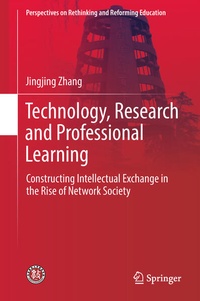
Technology, Research and Professional Learning
Constructing Intellectual Exchange in the Rise of Network Society
Published on 10. July 2018
Book
Hardback
XIX, 150 pages
978-981-13-0817-8 (ISBN)
Description
This book investigates the use of network technologies in research, and explores how such use potentially changes the nature of professional learning between academics. It attempts to situate the discussion of technology use in real-world research settings, to identify the different forms of participation in intellectual exchange embedded in academic dialogue, and to further contribute to knowledge on how the use of network technology potentially changes the nature of learning. Multiple data collection methods are employed, in two forms of study: a single case study, and a number of individual interviews. The single case study was carried out over a one-year period, and consisted of interviews (22 interviewees), observations, and document review. Individual semi-structured interviews were carried out over a similar period of time with a wider and different population of 24 academics from different Oxford faculties. Half of these were interviewed twice.The main findings presented in this book demonstrate that the direct consequences of technology use are changes to academic dialogue and scholarly communication in general. The change to this critical aspect of research - scholarly communication - has potentially led to more distributed research in interconnected research environments. It is the changes to scholarly communication and the research environment that consequently affect participation in intellectual exchange.
More details
Series
Edition
2018 ed.
Language
English
Place of publication
Singapore
Singapore
Target group
Professional and scholarly
Illustrations
12 farbige Abbildungen
XIX, 150 p. 12 illus. in color.
Dimensions
Height: 241 mm
Width: 160 mm
Thickness: 16 mm
Weight
430 gr
ISBN-13
978-981-13-0817-8 (9789811308178)
DOI
10.1007/978-981-13-0818-5
Schweitzer Classification
Other editions
Additional editions
Jingjing Zhang
Technology, Research and Professional Learning
Constructing Intellectual Exchange in the Rise of Network Society
Book
01/2019
Springer
€53.49
Shipment within 15-20 days
Jingjing Zhang
Technology, Research and Professional Learning
Constructing Intellectual Exchange in the Rise of Network Society
E-Book
06/2018
1st Edition
Springer
€53.49
Available for download
Person
Jingjing Zhang
is Director of the Big Data Centre for Technology-mediated Education at Beijing Normal University. She holds a PhD from Oxford University and has also trained at the OECD in Paris and the UN in New York. Her early research in machine learning and information visualization has led her to analyze university curriculum structure. In the past few years, her research has involved collaboration with educationists, sociologists and anthropologists. This has modified her research interests, giving them a focus on social constructivism of learning in real-world settings. She collaborates with scientists to develop data mining techniques (e.g. complex networking analysis) to explore human relationships and activities online, particularly in the learning sciences. This includes the impact on learning and collaboration produced by using open educational resources (OERs), massive open online courses (MOOCs), and knowledge visualization.
Content
Preface.- Part One: Historical and Theoretical Accounts.- 1 The Historical Accounts of the Use of Network Technologies in Academia.- 2 Theoretical Accounts of Technology and Learning.- 3 Challenges of Understanding Technology, Research, and Learning.- 4 Definitions and a Model.- Part Two: Scholars and Their Research Contexts.- 5 Interviewing Oxford Scholars.- 6 Wellcome Centre for Neuroethics at Oxford.- Part Three: Network Technology, Intellectual Exchange and Research.- 7 the Nature of Network Technology in Academia.- 8 Intellectual Exchange in Academic Dialogue.- 9 Changes to Scholarly Communication.- 10 Research Contexts Conducive to Intellectual Exchange.- 11 Conclusions.- Bibliography.- Appendices.