

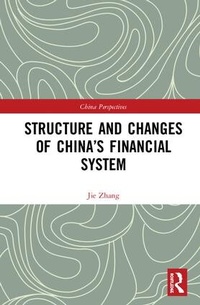
Structure and Changes of China's Financial System
1st Edition
Published on 10. May 2018
Book
Hardback
152 pages
978-1-138-90014-1 (ISBN)
Description
By virtue of several theoretical models and hypotheses, this book is one of the earliest studies which systematically investigates the structure and changes of China's financial institutions.
To begin with, it examines the relation between state utility function and China's economic growth, and reveals the formation and transition of China's state-owned financial institutional arrangements. Based on this analysis, the author studies the influence of monetization on the arrangements, and the financial support to China's gradual reform which have long been neglected by researchers. Also, the model of money demand that can explain the specific conditions of the gradual reform is built, as the neoclassical framework has been incapable of explaining China's financial performance. In the last chapter, it discusses the dilemma of property rights under the state-owned financial system, with the establishment of the credit equilibrium model and the dual model of bad debts.
With insightful theoretical analysis and empirical researches, this book will appeal to scholars and students in finance, economics and economic history.
To begin with, it examines the relation between state utility function and China's economic growth, and reveals the formation and transition of China's state-owned financial institutional arrangements. Based on this analysis, the author studies the influence of monetization on the arrangements, and the financial support to China's gradual reform which have long been neglected by researchers. Also, the model of money demand that can explain the specific conditions of the gradual reform is built, as the neoclassical framework has been incapable of explaining China's financial performance. In the last chapter, it discusses the dilemma of property rights under the state-owned financial system, with the establishment of the credit equilibrium model and the dual model of bad debts.
With insightful theoretical analysis and empirical researches, this book will appeal to scholars and students in finance, economics and economic history.
More details
Series
Language
English
Place of publication
London
United Kingdom
Publishing group
Taylor & Francis Ltd
Target group
College/higher education
Professional and scholarly
Illustrations
20 s/w Abbildungen, 20 s/w Zeichnungen, 25 s/w Tabellen
25 Tables, black and white; 20 Line drawings, black and white; 20 Illustrations, black and white
Dimensions
Height: 234 mm
Width: 156 mm
Weight
453 gr
ISBN-13
978-1-138-90014-1 (9781138900141)
Copyright in bibliographic data and cover images is held by Nielsen Book Services Limited or by the publishers or by their respective licensors: all rights reserved.
Schweitzer Classification
Other editions
Additional editions
Book
06/2020
1st Edition
Routledge
€51.98
Shipment within 15-20 days
E-Book
05/2018
1st Edition
Routledge
€59.49
Available for download
E-Book
05/2018
1st Edition
Routledge
€59.49
Available for download
Person
Jie Zhang is a Professor and the Head of the International Monetary Institute, Renmin University of China. His main research interests lie in the financial institution and financial development in China.
Content
List of figures
List of tables
Introduction
Chapter 1 The Institutional Structure, State and State-Owned Financial Institutional Arrangements
Chapter 2 Monetization and Financial Control by the State
Chapter 3 Financial Support to the Gradual Reform
Chapter 4 The Model of Money Demand During Transition
Chapter 5 Transitional Arrangements of the Financial System
Chapter 6 Dilemma of Property Rights under the State-Owned Financial System and the Path of Solution
Appendix Benefit and Cost of Financial Control by the State: Item Data
References
Index
List of tables
Introduction
Chapter 1 The Institutional Structure, State and State-Owned Financial Institutional Arrangements
Chapter 2 Monetization and Financial Control by the State
Chapter 3 Financial Support to the Gradual Reform
Chapter 4 The Model of Money Demand During Transition
Chapter 5 Transitional Arrangements of the Financial System
Chapter 6 Dilemma of Property Rights under the State-Owned Financial System and the Path of Solution
Appendix Benefit and Cost of Financial Control by the State: Item Data
References
Index