

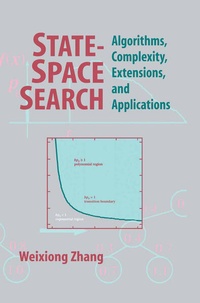
State-Space Search
Algorithms, Complexity, Extensions, and Applications
Published on 27. September 2012
Book
Paperback/Softback
XVI, 201 pages
978-1-4612-7183-3 (ISBN)
Description
This book is about problem solving. Specifically, it is about heuristic state-space search under branch-and-bound framework for solving com binatorial optimization problems. The two central themes of this book are the average-case complexity of heuristic state-space search algorithms based on branch-and-bound, and their applications to developing new problem-solving methods and algorithms. Heuristic state-space search is one of the fundamental problem-solving techniques in Computer Science and Operations Research, and usually constitutes an important component of most intelligent problem-solving systems. The search algorithms considered in this book can be classified into the category of branch-and-bound. Branch-and-bound is a general problem-solving paradigm, and is one of the best techniques for optimally solving computation-intensive problems, such as scheduling and planning. The main search algorithms considered include best-first search, depth first branch-and-bound, iterative deepening, recursive best-first search, and space-bounded best-first search. Best-first search and depth-first branch-and-bound are very well known and have been used extensively in Computer Science and Operations Research. One important feature of depth-first branch-and-bound is that it only requires space this is linear in the maximal search depth, making it very often a favorable search algo rithm over best-first search in practice. Iterative deepening and recursive best-first search are the other two linear-space search algorithms. Iterative deepening is an important algorithm in Artificial Intelligence, and plays an irreplaceable role in building a real-time game-playing program.
More details
Edition
Softcover reprint of the original 1st ed. 1999
Language
English
Place of publication
New York
United States
Target group
Professional and scholarly
Research
Illustrations
XVI, 201 p.
Dimensions
Height: 235 mm
Width: 155 mm
Thickness: 13 mm
Weight
341 gr
ISBN-13
978-1-4612-7183-3 (9781461271833)
DOI
10.1007/978-1-4612-1538-7
Schweitzer Classification
Other editions
Additional editions
E-Book
12/2012
Springer
€96.29
Available for download
Book
10/1999
Springer
€106.99
Shipment within 5-7 days
Content
1 State-Space Search for Problem Solving.- 1.1 Combinatorial Search Problems.- 1.2 Branch-and-Bound Methods.- 1.3 Bibliographical and Historical Remarks.- 2 Algorithms for Combinatorial Optimization.- 2.1 Algorithms for Optimal Solutions.- 2.2 Algorithms for Approximate Solutions.- 2.3 Bibliographical and Historical Remarks.- 3 Complexity of State-Space Search for Optimal Solutions.- 3.1 Incremental Random Trees.- 3.2 Problem Complexity and Cost of Optimal Goal.- 3.3 Best-First Search.- 3.4 Depth-First Branch-and-Bound.- 3.5 Iterative Deepening.- 3.6 Recursive and Space-Bounded Best-First Searches.- 3.7 Branching Factors.- 3.8 Summary of Search Complexity.- 3.9 Graphs Versus Trees.- 3.10 Bibliographical and Historical Remarks.- 4 Computational Complexity Transitions.- 4.1 Complexity Transition.- 4.2 Anomaly in Sliding-Tile Puzzles.- 4.3 Complexity Transition on the Asymmetric Traveling Salesman Problem.- 4.4 Bibliographical and Historical Remarks.- 5 Algorithm Selection.- 5.1 Comparison on Analytic Model.- 5.2 Comparison on Practical Problems.- 5.3 Summary.- 6 A Study of Branch-and-Bound on the Asymmetric Traveling Salesman Problem.- 6.1 Complexity of Branch-and-Bound Subtour Elimination.- 6.2 Local Search for the Asymmetric Traveling Salesman Problem.- 6.3 Finding Initial Tours.- 6.4 Depth-First Branch-and-Bound Versus Local Search.- 6.5 Bibliographical and Historical Remarks.- 7 State-Space Transformation for Approximation and Flexible Computation.- 7.1 Anytime Approximation Computation.- 7.2 Flexible Computation.- 7.3 State-Space Transformation.- 7.4 Properties of State-Space Transformation.- 7.5 Improvements and Extensions.- 7.6 Learning Edge-Cost Distribution and Branching Factor.- 7.7 Experimental Results.- 7.8 Bibliographical and Historical Remarks.- 8 Forward Pruning for Approximation and Flexible Computation, Part I: Single-Agent Combinatorial Optimization.- 8.1 Forward Pruning.- 8.2 Domain-Independent Pruning Heuristics.- 8.3 Forward Pruning as State-Space Transformation.- 8.4 Analyses.- 8.5 Learning Edge-Cost Distribution and Setting Parameters.- 8.6 Experimental Results.- 8.7 Summary and Discussion.- 8.8 Bibliographical and Historical Remarks.- 9 Forward Pruning for Approximation and Flexible Computation, Part II: Multiagent Game Playing.- 9.1 Minimax and Alpha-Beta Pruning.- 9.2 Forward Pruning.- 9.3 Playing Games.- 9.4 Summary and Discussion.- 9.5 Bibliographical and Historical Remarks.- A Basic Concepts of Branching Processes.- B Mathematical Notation.- C List of Algorithms.- References.