

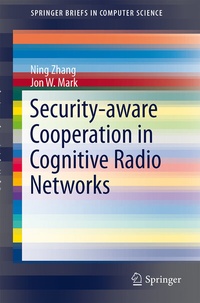
Security-aware Cooperation in Cognitive Radio Networks
Published on 31. January 2014
Book
Paperback/Softback
IX, 75 pages
978-1-4939-0412-9 (ISBN)
Description
This brief investigates spectrum efficient and energy efficient strategies, known as cognitive radio networks (CRNs), to ensure secure cooperation between licensed and unlicensed users. The authors address issues of spectrum scarcity, spectrum sensing, transmission performance, trust-aware cooperation, and secure communications.
Two security-aware cooperation based spectrum access schemes are presented. The first is a trust-aware cooperative framework for CRNs to improve the throughput or energy efficiency of licensed users and offer transmission opportunities to unlicensed users, taking into consideration the trustworthiness of unlicensed users. The second scheme is a cooperative framework to enhance secure communications of licensed users. An introduction to CRNs and literature survey enhance the discussion while numerical results are provided to demonstrate the viability of the proposed schemes.
The brief is designed for researchers and professionals working with cognitive radio networks or interested in cooperation based access. Advanced-level students studying computer communication networks and communications engineering will also find this brief useful.
More details
Series
Edition
2014 ed.
Language
English
Place of publication
New York
United States
Target group
Primary & secondary/elementary & high school
Graduate
Illustrations
27 s/w Abbildungen
IX, 75 p. 27 illus.
Dimensions
Height: 235 mm
Width: 155 mm
Thickness: 6 mm
Weight
149 gr
ISBN-13
978-1-4939-0412-9 (9781493904129)
DOI
10.1007/978-1-4939-0413-6
Schweitzer Classification
Other editions
Additional editions
Ning Zhang | Jon W. Mark
Security-aware Cooperation in Cognitive Radio Networks
E-Book
01/2014
1st Edition
Springer
€53.49
Available for download
Content
Introduction.- Cooperative Cognitive Radio Networking.- Trust-aware Cooperative Networking.- Cooperative Networking for Secure Communications.- Concluding Remarks.