

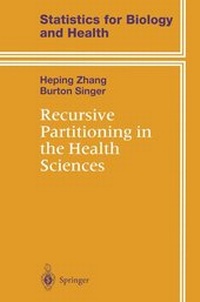
Recursive Partitioning in the Health Sciences
Published on 30. March 1999
Book
Hardback
XII, 226 pages
978-0-387-98671-5 (ISBN)
Description
Multiple complex pathways, characterized by interrelated events and con ditions, represent routes to many illnesses, diseases, and ultimately death. Although there are substantial data and plausibility arguments supporting many conditions as contributory components of pathways to illness and disease end points, we have, historically, lacked an effective methodology for identifying the structure of the full pathways. Regression methods, with strong linearity assumptions and data-based constraints on the extent and order of interaction terms, have traditionally been the strategies of choice for relating outcomes to potentially complex explanatory pathways. How ever, nonlinear relationships among candidate explanatory variables are a generic feature that must be dealt with in any characterization of how health outcomes come about. Thus, the purpose of this book is to demon strate the effectiveness of a relatively recently developed methodology recursive partitioning-as a response to this challenge. We also compare and contrast what is learned via recursive partitioning with results ob tained on the same data sets using more traditional methods. This serves to highlight exactly where--and for what kinds of questions-recursive partitioning-based strategies have a decisive advantage over classical re gression techniques. This book is suitable for three broad groups of readers: (1) biomedical re searchers, clinicians, public health practitioners including epidemiologists, health service researchers, environmental policy advisers; (2) consulting statisticians who can use the recursive partitioning technique as a guide in providing effective and insightful solutions to clients' problems; and (3) statisticians interested in methodological and theoretical issues.
Reviews / Votes
STATISTICAL METHODS IN MEDICAL RESEARCH
"The beauty of the Zhang and Singer's book is that it gives an excellent comparison between conventional regression models and recursive partitioning techniques. This comparative approach gives the reader insight into how a recursive partitioning technique can have an advantage over the conventional methods.Overall, the book provides an excellent introduction to tree based methods and their applications. It can be a good place to start learning about recursive partitioning. In addition, biostatisticians will enjoy the real life examples that have been used in the book."
More details
Series
Language
English
Place of publication
New York
United States
Target group
College/higher education
Professional and scholarly
Research
Illustrations
60 s/w Abbildungen
60 black & white illustrations
Dimensions
Height: 23.5 cm
Width: 15.5 cm
Thickness: 15 mm
Weight
1150 gr
ISBN-13
978-0-387-98671-5 (9780387986715)
DOI
10.1007/978-1-4757-3027-2
Schweitzer Classification
Other editions
New editions
Heping Zhang | Burton H. Singer
Recursive Partitioning and Applications
Book
07/2010
2nd Edition
Springer
€117.69
Shipment within 15-20 days
Additional editions
Heping Zhang | Burton H. Singer
Recursive Partitioning in the Health Sciences
E-Book
03/2013
Springer
€85.59
Available for download
Content
1 Introduction.- 2 A Practical Guide to Tree Construction.- 3 Logistic Regression.- 4 Classification Trees for a Binary Response.- 5 Risk-Factor Analysis Using Tree-Based Stratification.- 6 Analysis of Censored Data: Examples.- 7 Analysis of Censored Data: Concepts and Classical Methods.- 8 Analysis of Censored Data: Survival Trees.- 9 Regression Trees and Adaptive Splines for a Continuous Response.- 10 Analysis of Longitudinal Data.- 11 Analysis of Multiple Discrete Responses.- 12 Appendix.- References.