

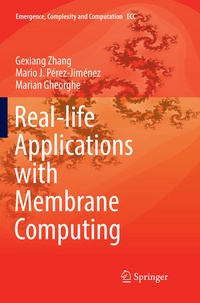
Real-life Applications with Membrane Computing
Published on 25. July 2018
Book
Paperback/Softback
XII, 355 pages
978-3-319-85798-5 (ISBN)
Description
This book thoroughly investigates the underlying theoretical basis of membrane computing models, and reveals their latest applications. In addition, to date there have been no illustrative case studies or complex real-life applications that capitalize on the full potential of the sophisticated membrane systems computational apparatus; gaps that this book remedies. By studying various complex applications - including engineering optimization, power systems fault diagnosis, mobile robot controller design, and complex biological systems involving data modeling and process interactions - the book also extends the capabilities of membrane systems models with features such as formal veri?cation techniques, evolutionary approaches, and fuzzy reasoning methods.
As such, the book offers a comprehensive and up-to-date guide for all researchers, PhDs and undergraduate students in the fields of computer science, engineering and the bio-sciences who are interested in the applications of natural computing models.
More details
Series
Edition
Softcover reprint of the original 1st ed. 2017
Language
English
Place of publication
Cham
Switzerland
Publishing group
Springer International Publishing
Target group
Professional and scholarly
Illustrations
94 s/w Abbildungen, 54 farbige Abbildungen
XII, 355 p. 148 illus., 54 illus. in color.
Dimensions
Height: 235 mm
Width: 155 mm
Thickness: 20 mm
Weight
557 gr
ISBN-13
978-3-319-85798-5 (9783319857985)
DOI
10.1007/978-3-319-55989-6
Schweitzer Classification
Other editions
Additional editions
Gexiang Zhang | Mario J. Pérez-Jiménez | Marian Gheorghe
Real-life Applications with Membrane Computing
Book
04/2017
Springer
€106.99
Shipment within 10-15 days
Persons
Gexiang Zhang: Full Professor and the Dean of School of Automation at Chengdu University of Information Technology, Chengdu, China, also the Director of Research Institute of Autonomous Intelligence Technology and Systems (RIAITS). He is a foreign member of Russian Academy of Natural Sciences, President of International Membrane Computing Society (IMCS), IET Fellow and IEEE Senior Member. He is listed in World's Top 2% Scientists by Stanford University and in Highly Cited Chinese Researchers by Elsevier in several consecutive years. Research areas include membrane computing, artificial intelligence, robotics, power systems, and their interactions.
Sergey Verlan: Full Professor at the IUT Sénart-Fontainebleau at the University of Paris Est Créteil, France, member of the steering committees for the International Conference on Membrane Computing and for the conference Machines, Computations and Universality. Member of the International Membrane Computing Society (IMCS). His research interests cover several topics, including membrane computing, natural/DNA computing, unconventional computing, formal language theory, study of complex dynamic systems, and FPGA digital circuit design and applications in biological modelling and robotics.
Tingfang Wu: Associate Professor at the Department of Computer Science and Technology at Soochow University, Suzhou, China. He received his Ph.D. from the Huazhong University of Science and Technology in 2018, and focused on the theory of spiking neural P systems. His research interests cover several topics, including membrane computing, neural network, and bioinformatics.
Francis George C. Cabarle: Tenured associate professor at the Department of Computer Science, University of the Philippines Diliman, Quezon City, Philippines. His M.Sc. (2012) and Ph.D. (2015) degrees from the same university focused on theory and implementation of spiking neural P systems (SN P systems). He is a member of the International Membrane Computing Society (IMCS), part of the organising committees for the International Conferences on Membrane Computing (European and Asian editions), an editorial board member of the journal Discover Computing (Springer), and other international conferences.
Jie Xue: Full Professor, Young Talents of Dongyue Scholars at Shandong Normal University, member of the International Membrane Computing Society (IMCS). She mainly engaged in membrane computing, artificial intelligence algorithm and application in medical image management, especially for clinical problems of brain tumor, fundus lesion, and pancreatic cancer. She has published more than 40 journal papers in related fields.
David OrellanäMartín: Assistant Professor at the Department of Computer Science and Artificial Intelligence at Universidad de Sevilla, he received his B.Sc. degree in 2014, his M.Sc. degree in 2016, and his Ph.D. degree in 2019 at the University of Seville. His main research interests are computational complexity theory, unconventional computing (especially membrane computing), as well as machine learning and high-performance computing.
Jianping Dong: Lecturer at the School of Automation at Chengdu University of Information Technology, Chengdu, China, He received his Ph.D. degree in 2024 from Chengdu University of Technology, Chengdu, China, and his M.S. degree at School of Electrical Engineering from Southwest Jiaotong University, Chengdu, China. His current research interests include membrane computing, image processing and optimization algorithms.
Luis Valencia-Cabrera: Associate Professor at the Department of Computer Science and Artificial Intelligence at Universidad de Sevilla. He received his degree in Computer Engineering, his MSc and his Ph.D. in Logic, Computation and Artificial Intelligence from the University of Seville, Seville, Spain. His main research interests include complex systems modelling and simulation, natural comp
Content
Membrane Computing - Key Concepts and De?nitions.- Fundamentals of Evolutionary Computation.- Membrane Algorithms.- Engineering Optimization with Membrane Algorithms.- Electric Power System Fault Diagnosis with Membrane Systems.- Robot Control with Membrane Systems.- Data Modeling with Membrane Systems: Applications to Real Ecosystems.