

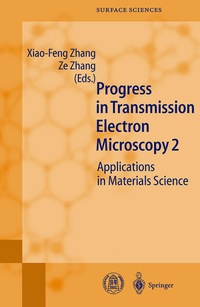
Progress in Transmission Electron Microscopy 2
Applications in Materials Science
Published on 18. October 2001
Book
Hardback
XIV, 307 pages
978-3-540-67681-2 (ISBN)
Description
Transmission electron microscopy (TEM) is now recognized as a crucial tool in materials science. This book, authored by a team of expert Chinese and international authors, covers many aspects of modern electron microscopy, from the architecture of novel electron microscopes, advanced theories and techniques in TEM and sample preparation, to a variety of hands-on examples of TEM applications. Volume II illustrates the important role that TEM is playing in the development and characterization of advanced materials, including nanostructures, interfacial structures, defects, and macromolecular complexes.
More details
Series
Edition
2001 ed.
Language
English
Place of publication
Berlin
Germany
Publishing group
Springer Berlin
Target group
Professional and scholarly
Research
Illustrations
XIV, 307 p.
Dimensions
Height: 23.5 cm
Width: 15.5 cm
Weight
1420 gr
ISBN-13
978-3-540-67681-2 (9783540676812)
Schweitzer Classification
Other editions
Additional editions
Xiao-Feng Zhang | Ze Zhang
Progress in Transmission Electron Microscopy 2
Applications in Materials Science
Book
10/2010
Springer
€106.99
Article exhausted; check different version
Content
1. The Guidance Role of HRTEM in Developing Mesoporous Molecular Sieves.- 2. HREM Study of Carbon Nanoclusters Grown from Carbon Arc-Discharge.- 3. Determining the Helicity of Carbon Nanotubes by Electron Diffraction.- 4. Low-Dimensional Materials and their Microstructures Studied by High-Resolution Electron Microscopy.- 5. Microstructure of High-Tc Superconducting Josephson Junctions.- 6. Swift Heavy Ion Irradiation Damage in Superconductors.- 7. TEM Investigations of Misfit Dislocations in Lattice-Mismatched Semiconductor Heterostructures.- 8. Dislocated Contrast Analysis.- 9. Transmission Electron Cryomicroscopy and Three-Dimensional Reconstruction of Macromolecular Complexes.