

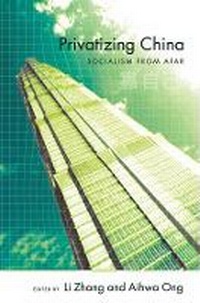
Privatizing China
Socialism from Afar
Published on 28. February 2008
Book
Hardback
296 pages
978-0-8014-4596-5 (ISBN)
Description
Everyday life in China is increasingly shaped by a novel mix of neoliberal and socialist elements, of individual choices and state objectives. This combination of self-determination and socialism from afar has incited profound changes in the ways individuals think and act in different spheres of society.
Covering a vast range of daily life-from homeowner organizations and the users of Internet cafes to self-directed professionals and informed consumers-the essays in Privatizing China create a compelling picture of the burgeoning awareness of self-governing within the postsocialist context. The introduction by Aihwa Ong and Li Zhang presents assemblage as a concept for studying China as a unique postsocialist society created through interactions with global forms.
The authors conduct their ethnographic fieldwork in a spectrum of domains-family, community, real estate, business, taxation, politics, labor, health, professions, religion, and consumption-that are infiltrated by new techniques of the self and yet also regulated by broader socialist norms. Privatizing China gives readers a grounded, fine-grained intimacy with the variety and complexity of everyday conduct in China's turbulent transformation.
Covering a vast range of daily life-from homeowner organizations and the users of Internet cafes to self-directed professionals and informed consumers-the essays in Privatizing China create a compelling picture of the burgeoning awareness of self-governing within the postsocialist context. The introduction by Aihwa Ong and Li Zhang presents assemblage as a concept for studying China as a unique postsocialist society created through interactions with global forms.
The authors conduct their ethnographic fieldwork in a spectrum of domains-family, community, real estate, business, taxation, politics, labor, health, professions, religion, and consumption-that are infiltrated by new techniques of the self and yet also regulated by broader socialist norms. Privatizing China gives readers a grounded, fine-grained intimacy with the variety and complexity of everyday conduct in China's turbulent transformation.
Reviews / Votes
"Privatizing China is an outstanding contribution to the literature on the extraordinary changes taking place in China today. Its authors analyze fresh evidence through new and compelling frameworks that capture the often contradictory but always fascinating 'assemblages' that constitute Chinese social, economic, cultural, and political life. All of the essays adopt a mode of presentation and argumentation that moves back and forth between theoretical commentary and ethnographic description; all are clearly written, highly accessible, moving, and evocative in their storytelling."-Susan Greenhalgh, University of California, Irvine "Privatizing China is an important book that deserves a close reading by all scholars interested in postsocialist societies and/or twenty-first-century socialisms. Contributors explore China's headlong plunge into the privatization of housing, urban land, labor, consumption practices, health care, and new media. This is anthropology at its very best."-James L. Watson, Fairbank Professor of Chinese Society and Professor of Anthropology, Harvard UniversityMore details
Language
English
Place of publication
Ithaca
United States
Product notice
Paper over boards
Dimensions
Height: 235 mm
Width: 155 mm
Thickness: 24 mm
Weight
907 gr
ISBN-13
978-0-8014-4596-5 (9780801445965)
Copyright in bibliographic data and cover images is held by Nielsen Book Services Limited or by the publishers or by their respective licensors: all rights reserved.
Schweitzer Classification
Other editions
Additional editions
E-Book
07/2015
Cornell University Press
€25.49
Available for download
Persons
Li Zhang is Associate Professor of Anthropology at the University of California, Davis. She is the author of Strangers in the City. Aihwa Ong is Professor of Anthropology at the University of California, Berkeley. She is the author of several books, including Neoliberalism as Exception, Buddha Is Hiding, and Flexible Citizenship.
Content
Introduction: Privatizing China: Powers of the Self, Socialism from Afar by Aihwa Ong and Li Zhang PART I. POWERS OF PROPERTY Emerging Class Practices 1. Private Homes, Distinct Lifestyles: Performing a New Middle Class by Li Zhang 2. Property Rights and Homeowner Activism in New Neighborhoods by Benjamin L. Read Accumulating Land and Money 3. Socialist Land Masters: The Territorial Politics of Accumulation by You-tien Hsing 4. Tax Tensions: Struggles over Income and Revenue by Bei Li and Steven M. Sheffrin Negotiating Neoliberal Values 5. "Reorganized Moralism": The Politics of Transnational Labor Codes by Pun Ngai 6. Neoliberalism and Hmong/Miao Transnational Media Ventures by Louisa Schein PART II.POWERS OF THE SELF Taking Care of One's Health 7. Consuming Medicine and Biotechnology in China by Nancy N. Chen 8. Should I Quit?: Tobacco, Fraught Identity, and the Risks of Governmentality by Matthew Kohrman 9.Wild Consumption: Relocating Responsibilities in the Time of SARS by Mei Zhan Managing the Professional Self 10. Post-Mao Professionalism: Self-enterprise and Patriotism by Lisa M. Hoffman 11. Self-fashioning Shanghainese: Dancing across Spheres of Value by Aihwa Ong Search for the Self in New Publics 12. Living Buddhas, Netizens, and the Price of Religious Freedom by Dan Smyer Yu 13. Privatizing Control: Internet Cafes in China by Zhou Yongming Afterword: Thinking Outside the Leninist Corporate Box by Ralph A. Litzinger Notes Contributors Index