

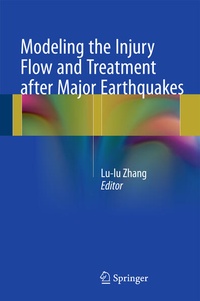
Modeling the Injury Flow and Treatment after Major Earthquakes
Published on 9. May 2016
Book
Hardback
V, 215 pages
978-94-017-7525-0 (ISBN)
Description
This book discuss a series of earthquake emergency medical rescue complex models, which can provide theoretical support for medical disaster rescue work in the future.
This book consists of three parts. The first part is an introduction (chapter 1) which makes an overview of the purpose, meaning, methods and relative theory using in the research. The second part (chapter 2 to 8) includes "casualty flow" related factors such as the occurrences of earthquake casualty, the Length of Stay among the Hospitalized Patients, the medical evacuation in earthquake and rescue force related factors such as the medical rescue forces allocation in earthquake, the organization and command of earthquake rescue forces, Location and Distribution of Medical Rescue Institutions and from peacetime to wartime in hospital. The third part (chapter 9) is a summary including conclusion and policy-making suggestion.
More details
Edition
1st ed. 2016
Language
English
Place of publication
Dordrecht
Netherlands
Target group
Professional and scholarly
Professional/practitioner
Illustrations
38 farbige Abbildungen, 7 s/w Abbildungen
V, 215 p. 45 illus., 38 illus. in color.
Dimensions
Height: 241 mm
Width: 160 mm
Thickness: 15 mm
Weight
547 gr
ISBN-13
978-94-017-7525-0 (9789401775250)
DOI
10.1007/978-94-017-7527-4
Schweitzer Classification
Other editions
Additional editions
Book
05/2018
Springer
€160.49
Shipment within 15-20 days
E-Book
04/2016
Springer
€96.29
Available for download
Person
Editor Lu-lu Zhang is a Professor at the Institute of Military Health Management, Second Military Medical University, Shanghai, China.
Content
Introduction.- Modeling the occurrences of earthquake casualties.- Logistic Regression Modeling the Length of Stay among the Hospitalized Patients after the 2010 Yushu Earthquake.- Modeling earthquake-related medical evacuation .- Modeling the medical rescue forces allocation in earthquakes.- Modeling the organization and command of earthquake rescue forces.- Modeling Location and Distribution of Medical Support Institutions.- Modeling hospital transition from peacetime to wartime.- Summary.