

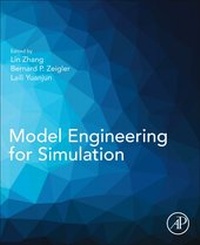
Model Engineering for Simulation
Published on 1. March 2019
Book
Paperback/Softback
453 pages
978-0-12-813543-3 (ISBN)
Description
Model Engineering for Simulation provides a systematic introduction to the implementation of generic, normalized and quantifiable modeling and simulation using DEVS formalism. It describes key technologies relating to model lifecycle management, including model description languages, complexity analysis, model management, service-oriented model composition, quantitative measurement of model credibility, and model validation and verification. The book clearly demonstrates how to construct computationally efficient, object-oriented simulations of DEVS models on parallel and distributed environments.
More details
Language
English
Place of publication
San Diego
United States
Publishing group
Elsevier Science Publishing Co Inc
Target group
College/higher education
Mathematically-inclined early career researchers in systems and control engineering, and computer science. Grad students and PhD students may also use this (as a supplementary reference or course text reference).
Dimensions
Height: 235 mm
Width: 191 mm
Weight
1040 gr
ISBN-13
978-0-12-813543-3 (9780128135433)
Copyright in bibliographic data and cover images is held by Nielsen Book Services Limited or by the publishers or by their respective licensors: all rights reserved.
Schweitzer Classification
Other editions
Additional editions
Lin Zhang | Bernard P. Zeigler | Yuanjun Laili
Model Engineering for Simulation
E-Book
02/2019
Academic Press
€86.99
Available for download
Persons
Lin Zhang is Professor of Computer and Systems Science at Beihang Unversity. He received the B.S. degree in 1986 from the Department of Computer and System Science at Nankai University, China. He received the M.S. degree and the Ph.D. degree in 1989 and 1992 from the Department of Automation at Tsinghua University, China. He served as the director of CIMS Office, China National 863 Program, from 1997 to 2001. From 2002 to 2005 he worked at the US Naval Postgraduate School as a senior research associate of the US National Research Council. Currently, he serves as the immediately past President of the Society for Modeling & Simulation International (SCS), a Fellow of the Federation of Asian Simulation Societies (ASIASIM), the executive vice president of Chinese Association for System Simulation (CASS), an IEEE senior member, a chief scientist of the 863 key projects, and associate Editor-in-Chief and associate editor of 5 peer-reviewed international journals. He has authored and co-authored 160 papers, 5 books and chapters. His research interests include service oriented modeling and simulation, agent based control and simulation, cloud manufacturing, model engineering. Bernard P. Zeigler, is a Professor of Electrical & Computer Engineering at the University of Arizona and co-director of the Arizona Center for Integrative Modeling and Simulation. He is the author of numerous books and publications, a Fellow of the IEEE, and of the Society for Modeling and Simulation International. Zeigler is currently heading a project for the Joint Interoperability Test Command (JITC) where he is leading the design of the future architecture for large distributed simulation events for the Joint Distributed Engineering Plant (JDEP). He is also developing DEVS-methodology approaches for testing mission thread end-to-end interoperability and combat effectiveness of Defense Department acquisitions and transitions to the Global Information Grid with its Service Oriented Architecture (GIG/SOA). Yuanjun Laili, is Assistant Professor of Electrical Engineering at Beihang Unversity, China. She received the B.S., M.S. and Ph.D. degree from the School of Automation Science and Electrical Engineering at Beihang University in 2009, 2012 and 2015, respectively. She is a member of the Society for Modeling & Simulation International (SCS). She has authored and coauthored 13 papers and one book. Her research interests include service oriented manufacturing, modeling and simulation, configurable intelligent optimization. She obtained outstanding doctoral dissertations of the Chinese Society of System Simulation in 2015.
Content
1. History of Subsurface Development
2. Planning the Use of the Subsurface
3. Design of Underground Structures
4. Underground Constructions
5. Project Management in Underground Engineering
6. Operation System in Underground Engineering
7. Disasters and Protection in Underground Engineering
8. Acknowledgements
2. Planning the Use of the Subsurface
3. Design of Underground Structures
4. Underground Constructions
5. Project Management in Underground Engineering
6. Operation System in Underground Engineering
7. Disasters and Protection in Underground Engineering
8. Acknowledgements