

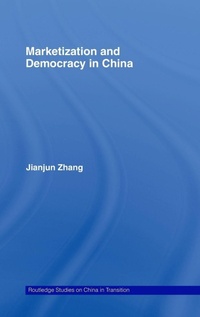
Marketization and Democracy in China
1st Edition
Published on 12. February 2008
Book
Hardback
292 pages
978-0-415-45222-9 (ISBN)
Description
Since China began an era of market reform three decades ago, many Westerners believed that, political liberalization and, eventually, democracy would follow. However, contrary to Western expectations, China remains an authoritarian country and the communist party is still in power, even though the country has witnessed rapid economic growth and its people have become richer.
In Marketization and Democracy in China, Jianjun Zhang questions whether China's market reforms have created favorable social conditions for democracy, whether the country's emerging entrepreneurial class will serve as the democratic social base, and the role of government in the process of transition. Based upon a careful analysis of two regions-Sunan and Wenzhou -the two prototypical local development patterns in China, Zhang finds that different patterns of economic development have produced distinct local-level social and political configurations, only one of which is likely to foster the growth of democratic practices. The results suggest that China's political future is largely dependent upon the emerging class structure and offer a warning on China's development: if market reforms and economic development only enrich a few, then democratic transition will be unlikely.
Marketization and Democracy in China will be of interest to scholars of Chinese politics, political science and development studies.
In Marketization and Democracy in China, Jianjun Zhang questions whether China's market reforms have created favorable social conditions for democracy, whether the country's emerging entrepreneurial class will serve as the democratic social base, and the role of government in the process of transition. Based upon a careful analysis of two regions-Sunan and Wenzhou -the two prototypical local development patterns in China, Zhang finds that different patterns of economic development have produced distinct local-level social and political configurations, only one of which is likely to foster the growth of democratic practices. The results suggest that China's political future is largely dependent upon the emerging class structure and offer a warning on China's development: if market reforms and economic development only enrich a few, then democratic transition will be unlikely.
Marketization and Democracy in China will be of interest to scholars of Chinese politics, political science and development studies.
Reviews / Votes
'Dr Zhang's book has a very clear thesis, and looks at a further dimension of this issue of partial democratisation and participation in major decision-making in China' - Kerry Brown, Asian Affairs, March 2009More details
Series
Language
English
Place of publication
London
United Kingdom
Publishing group
Taylor & Francis Ltd
Target group
College/higher education
Illustrations
11 s/w Zeichnungen, 23 s/w Tabellen
23 Tables, black and white; 11 Line drawings, black and white
Dimensions
Height: 240 mm
Width: 161 mm
Thickness: 21 mm
Weight
622 gr
ISBN-13
978-0-415-45222-9 (9780415452229)
Copyright in bibliographic data and cover images is held by Nielsen Book Services Limited or by the publishers or by their respective licensors: all rights reserved.
Schweitzer Classification
Other editions
Additional editions
Jianjun Zhang
Marketization and Democracy in China
Book
12/2009
1st Edition
Routledge
€71.70
Shipment within 15-20 days
Jianjun Zhang
Marketization and Democracy in China
E-Book
02/2008
Routledge
€64.49
Available for download
Jianjun Zhang
Marketization and Democracy in China
E-Book
02/2008
Routledge
€64.49
Available for download
Jianjun Zhang
Marketization and Democracy in China
E-Book
02/2008
1st Edition
Routledge
€134.39
Available for download
Person
Jianjun Zhang is Assistant Professor in the Guanghua School of Management, Peking University, China.
Content
1. Introduction Part 1: Development Patterns and the Evolution of Property Rights 2. Emergence of the Two Development Patterns 3. Changing Power Relations 4. Privatization of TVEs Part 2: Class Structure and Elite Relations 5. Polarized versus Equalized Class Structure 6. Elite Relations in Sunan 7. Elite Relations in Wenzhou Part 3: Political Consequences 8. Top-down versus Bottom-up Business Associations 9. Controlled versus Competitive Village Elections 10. Conclusion