

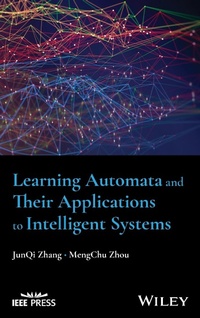
Learning Automata and Their Applications to Intelligent Systems
1st Edition
Published on 16. November 2023
Book
Hardback
272 pages
978-1-394-18849-9 (ISBN)
Description
"A learning automaton represents an important and powerful tool in the area of reinforcement learning and aims at learning the optimal one that maximizes the probability of being rewarded out of a set of allowable systems, actions, alternatives, candidates, or designs by the interaction with a random environment. During a cycle, an automaton chooses an action and then receives a stochastic response that can be either a reward or penalty from the environment. The action probability vector of choosing the next action is then updated by employing this response. The ability of learning how to choose the optimal action endows learning automata with high adaptability to the environment, thus saving great expense and time to find the optimal one in various difficult stochastic environments."--
More details
Product info
HC gerader Rücken kaschiert
Language
English
Place of publication
New York
United States
Publishing group
John Wiley & Sons Inc
Target group
Professional and scholarly
Dimensions
Height: 235 mm
Width: 157 mm
Thickness: 19 mm
Weight
548 gr
ISBN-13
978-1-394-18849-9 (9781394188499)
Copyright in bibliographic data and cover images is held by Nielsen Book Services Limited or by the publishers or by their respective licensors: all rights reserved.
Schweitzer Classification
Other editions
Additional editions
JunQi Zhang | MengChu Zhou
Learning Automata and Their Applications to Intelligent Systems
E-Book
11/2023
1st Edition
Wiley
€115.99
Available for download
JunQi Zhang | MengChu Zhou
Learning Automata and Their Applications to Intelligent Systems
E-Book
11/2023
1st Edition
Wiley
€115.99
Available for download
Persons
JunQi Zhang, PhD, is a Full Professor with Tongji University in Shanghai. He has published 10+ papers in IEEE Transactions and 30+ papers in conferences. His current research interests include learning automata, swarm intelligence, swarm robots, multi-agent systems, reinforcement learning, and big data.
MengChu Zhou, PhD, is a Distinguished Professor at New Jersey Institute of Technology. He has over 1100 publications including 14 books, 750+ journal papers (600+ in IEEE transactions), 31 patents, and 32 book-chapters. He is Fellow of IEEE, IFAC, AAAS, CAA and NAI.
Content
About the Authors
Preface and Acknowledgements
A Guide to Reading This Book
1 Introduction
1.1 Ranking and selection in Noisy Optimization
1.2 Learning Automata and Ordinal Optimization
1.3 Exercises
References
2 Learning Automata
2.1 Environment and Automaton
2.1.1 The Environment
2.1.2 The Automaton
2.1.3 Deterministic and Stochastic Automata
2.1.4 Measured Norms
2.2 Fixed Structure Learning Automata
2.2.1 Tsetlin Learning Automaton
2.2.2 Krinsky Learning Automaton
2.2.3 Krylov Learning Automaton
2.2.4 IJA Learning Automaton
2.3 Variable Structure Learning Automata
2.3.1 Estimator-Free Learning Automaton
2.3.2 Deterministic Estimator Learning Automaton
2.3.3 Stochastic Estimator Learning Automaton
2.4 Summary
2.5 Exercises
References
3 Fast Learning Automata
3.1 Last-position Elimination-based Learning Automata
3.1.1 Background and Motivation
3.1.2 Principles and Algorithm Design
3.1.3 Difference Analysis
3.1.4 Simulation Studies
3.1.5 Summary
3.2 Fast Discretized Pursuit Learning Automata
3.2.1 Background and Motivation
3.2.2 Algorithm Design of Fast Discretized Pursuit LA
3.2.3 Optimality Analysis
3.2.4 Simulation Studies
3.2.5 Summary
3.3 Exercises
References
4 Application-Oriented Learning Automata (55 pages)
4.1 Discovering and Tracking Spatiotemporal Event Patterns
4.1.1 Background and Motivation
4.1.2 Spatiotemporal Pattern Learning Automata
4.1.3 Adaptive Tunable Spatiotemporal Pattern Learning Automata
4.1.4 Optimality Analysis
4.1.5 Simulation Studies
4.1.6 Summary
4.2 Stochastic Searching on the Line
4.2.1 Background and Motivation
4.2.2 Symmetrical Hierarchical Stochastic Searching on the Line
4.2.3 Simulation Studies
4.2.4 Summary
4.3 Fast Adaptive Search on the Line in Dual Environments
4.3.1 Background and Motivation
4.3.2 Symmetrized ASS with Buffer
4.3.3 Simulation Studies
4.3.4 Summary
4.4 Exercises
References
5 Ordinal Optimization (51 pages)
5.1 Optimal Computing-Budget Allocation
5.2 Optimal Computing-Budget Allocation for Selection of Best and Worst Designs
5.2.1 Background and Motivation
5.2.2 Approximate Optimal Simulation Budget Allocation
5.2.3 Simulation Studies
5.2.4 Summary
5.3 Optimal Computing-Budget Allocation for Subset Ranking
5.3.1 Background and Motivation
5.3.2 Approximate Optimal Simulation Budget Allocation
5.3.3 Simulation Studies
5.3.4 Summary
5.4 Exercises
References
6 Incorporation of Ordinal Optimization into Learning Automata (22 pages)
6.1 Background and Motivation
6.2 Learning Automata with Optimal Computing Budget Allocation
6.3 Proof of Optimality
6.4 Simulation Studies
6.5 Summary
6.6 Exercises
References
7 Noisy Optimization Applications (31 pages)
7.1 Background and Motivation
7.2 Particle Swarm Optimization
7.2.1 Parameters Configurations
7.2.2 Topology Structures
7.2.3 Hybrid PSO
7.2.4 Multiswarm Techniques
7.3 Resampling for Noisy Optimization Problems
7.4 PSO-Based LA and OCBA
7.5 Simulation Studies
7.6 Summary
7.7 Exercises
References
8 Applications and Future Research Directions of Learning Automata (19 pages)
8.1 Summary of Existing Applications
8.1.1 Classification
8.1.2 Clustering
8.1.3 Games
8.1.4 Knapsack Problems
8.1.5 Decision Problems in Networks
8.1.6 Optimization
8.1.7 LA Parallelization and Design Ranking
8.1.8 Scheduling
8.2 Future Research Directions
8.3 Exercises
References
Index