

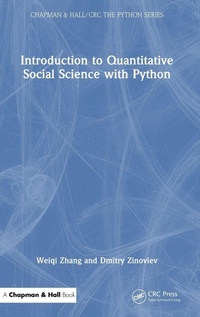
Introduction to Quantitative Social Science with Python
1st Edition
Published on 1. November 2024
Book
Hardback
332 pages
978-1-032-35460-6 (ISBN)
Description
Departing from traditional methodologies of teaching data analysis, this book presents a dual-track learning experience, with both Executive and Technical Tracks, designed to accommodate readers with various learning goals or skill levels. Through integrated content, readers can explore fundamental concepts in data analysis while gaining hands-on experience with Python programming, ensuring a holistic understanding of theory and practical application in Python.
Emphasizing the practical relevance of data analysis in today's world, the book equips readers with essential skills for success in the field. By advocating for the use of Python, an open-source and versatile programming language, we break down financial barriers and empower a diverse range of learners to access the tools they need to excel.
Whether you're a novice seeking to grasp the foundational concepts of data analysis or a seasoned professional looking to enhance your programming skills, this book offers a comprehensive and accessible guide to mastering the art and science of data analysis in social science research.
Key Features:
Dual-track learning: Offers both Executive and Technical Tracks, catering to readers with varying levels of conceptual and technical proficiency in data analysis.
Includes comprehensive quantitative methodologies for quantitative social science studies.
Seamless integration: Interconnects key concepts between tracks, ensuring a smooth transition from theory to practical implementation for a comprehensive learning experience.
Emphasis on Python: Focuses on Python programming language, leveraging its accessibility, versatility, and extensive online support to equip readers with valuable data analysis skills applicable across diverse domains.
Emphasizing the practical relevance of data analysis in today's world, the book equips readers with essential skills for success in the field. By advocating for the use of Python, an open-source and versatile programming language, we break down financial barriers and empower a diverse range of learners to access the tools they need to excel.
Whether you're a novice seeking to grasp the foundational concepts of data analysis or a seasoned professional looking to enhance your programming skills, this book offers a comprehensive and accessible guide to mastering the art and science of data analysis in social science research.
Key Features:
Dual-track learning: Offers both Executive and Technical Tracks, catering to readers with varying levels of conceptual and technical proficiency in data analysis.
Includes comprehensive quantitative methodologies for quantitative social science studies.
Seamless integration: Interconnects key concepts between tracks, ensuring a smooth transition from theory to practical implementation for a comprehensive learning experience.
Emphasis on Python: Focuses on Python programming language, leveraging its accessibility, versatility, and extensive online support to equip readers with valuable data analysis skills applicable across diverse domains.
Reviews / Votes
"One of the standout features of this book is its innovative dual-track layout, which balances the foundational theories with practical programming skills, catering to a wide range of readers. The executive track focuses on providing intuitive and conceptual explanations of statistical concepts using relevant examples, offering a high-level understanding of essential social science methods. On the other hand, the technical track illustrates these statistical methods through hands-on Python programming. By making advanced data-driven analysis feel approachable without losing depth, the book will benefit students and researchers from non-technical fields. I believe that this book will be a valuable resource for those who are stepping into quantitative social science analysis."-Salil Koner, Journal of the American Statistical Association, March 2026.
More details
Series
Language
English
Place of publication
Boca Raton
United Kingdom
Publishing group
Taylor & Francis Ltd
Target group
Professional and scholarly
Academic
Illustrations
66 s/w Abbildungen, 1 s/w Photographie bzw. Rasterbild, 65 s/w Zeichnungen, 39 s/w Tabellen
39 Tables, black and white; 65 Line drawings, black and white; 1 Halftones, black and white; 66 Illustrations, black and white
Dimensions
Height: 240 mm
Width: 161 mm
Thickness: 24 mm
Weight
699 gr
ISBN-13
978-1-032-35460-6 (9781032354606)
Copyright in bibliographic data and cover images is held by Nielsen Book Services Limited or by the publishers or by their respective licensors: all rights reserved.
Schweitzer Classification
Other editions
Additional editions
Weiqi Zhang | Dmitry Zinoviev
Introduction to Quantitative Social Science with Python
E-Book
11/2024
1st Edition
Chapman and Hall
€69.99
Available for download
Weiqi Zhang | Dmitry Zinoviev
Introduction to Quantitative Social Science with Python
E-Book
11/2024
1st Edition
Chapman and Hall
€69.99
Available for download
Weiqi Zhang | Dmitry Zinoviev
Introduction to Quantitative Social Science with Python
Book
11/2024
1st Edition
Chapman & Hall/CRC
€77.70
Shipment within 10-20 days
Persons
Weiqi Zhang is an Associate Professor at Suffolk University. He teaches courses on political science and data analytics, and he is passionate about bridging social sciences and data science.
Dmitry Zinoviev is a Professor of Computer Science at Suffolk University. His academic interests include computer modeling and simulation, complex networks, and the integration of computational methods into traditionally non-quantitative fields such as the humanities and social sciences.
Dmitry Zinoviev is a Professor of Computer Science at Suffolk University. His academic interests include computer modeling and simulation, complex networks, and the integration of computational methods into traditionally non-quantitative fields such as the humanities and social sciences.
Content
Part 1: "Executive Track" 1. Introduction to Data Analysis in Social Science 2. Data Collection and Cleaning 3. Descriptive and Exploratory Analysis 4. Causality and Hypothesis Testing 5. Linear Regression Analysis 6. Classification 7. Complex Network Analysis 8. Text As Data Part 2: "Technical Track" 9. Python Programming Fundamentals 10. Data Collection and Cleaning 11. Condition Checking and Descriptive and Exploratory Analysis 12. Loops and Hypothesis Testing 13. User-Defined Functions and Regression Analysis 14. Generators and Classification 15. More Generators and Network Analysis 16. Sets. Text as Data Conclusion A. Solutions to Select Exercises Bibliography