

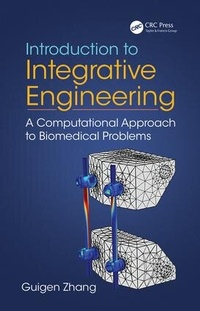
Introduction to Integrative Engineering
A Computational Approach to Biomedical Problems
1st Edition
Published on 1. March 2017
Book
Hardback
424 pages
978-1-4665-7228-7 (ISBN)
Description
This textbook is designed for an introductory course at undergraduate and graduate levels for bioengineering students. It provides a systematic way of examining bioengineering problems in a multidisciplinary computational approach. The book introduces basic concepts of multidiscipline-based computational modeling methods, provides detailed step-by-step techniques to build a model with consideration of underlying multiphysics, and discusses many important aspects of a modeling approach including results interpretation, validation, and assessment.
More details
Language
English
Place of publication
Bosa Roca
United States
Publishing group
Taylor & Francis Inc
Target group
College/higher education
Illustrations
200 s/w Abbildungen
200 Illustrations, black and white
Dimensions
Height: 234 mm
Width: 156 mm
Weight
952 gr
ISBN-13
978-1-4665-7228-7 (9781466572287)
Copyright in bibliographic data and cover images is held by Nielsen Book Services Limited or by the publishers or by their respective licensors: all rights reserved.
Schweitzer Classification
Other editions
Additional editions
E-Book
03/2017
1st Edition
CRC Press
€185.99
Available for download
E-Book
03/2017
CRC Press
€185.99
Available for download
Person
Guigen Zhang, Ph.D., is Professor of Bioengineering and Professor of Electri- cal and Computer Engineering at Clemson University. He is also the Executive Director of the Institute for Biological Interfaces of Engineering, a research and education/training institute designated by the South Carolina Commission on Higher Education. Professor Zhang is a fellow of the American Institute for Medical and Biological Engineering (AIMBE). He has published extensively in the areas of biosensors, biomechanics, biomaterials and computational modeling. Over the years, his research has been funded by diverse funding sources ranging from federal agencies such as National Institutes for Health and National Science Foundation, to private foundations like the Bill and Melinda Gates Foundation, to venture groups and state-level startup funds, as well as industries in the health-care, semiconductors, and data-storage sectors. Professor Zhang holds numerous patents in nanotechnology-enhanced structures and biosensors. Aside from his services on the editorial boards of numerous scientific journals, Pro- fessor Zhang is also active in serving leadership roles in professional societies. He is currently the Executive Editor of the Biomaterials Forum of the Society For Biomaterials (SFB), and President of the Institute of Biological Engineer- ing (IBE), a professional society that supports the community of scientists and engineers who are at the forefront of creating new linkages between biology and engineering and seeking new opportunities through Biology-Inspired engineering.
Content
I Readying the Integrative Mindset
1 From Compartmentalized Disciplines to Transdiscipline
II Cracking Open the Blackbox of Computational Modeling
2 Engineering Problems and Partial Differential Equations
3 Where Do Differential Equations Come From?
4 Approximate Solutions to Differential Equations
5 Discretization of Physical Domains
6 Solving Differential Equations Computationally
7 Scalar Field Problems in Higher Dimensions8 Vector Field Problems in Higher Dimensions
9 Axisymmetric Scalar and Vector Field Problems
10 Isoparametric Elements
11 Gauss Quadrature and Numerical Integration
12 Dealing with Generalized PDEs13 Errors in FEM Results
III Developing Hands-On Modeling Skills 327
14 A Quick Tour of the COMSOL Modeling Environment
15 A Glimpse of the ABAQUS and ANSYS User Interfaces16 Dealing with Problems of Biomedical and Regulatory Interest
IV Useful Knowledge
A Mechanics of Materials
B Useful Mathematic Knowledge
Index
1 From Compartmentalized Disciplines to Transdiscipline
II Cracking Open the Blackbox of Computational Modeling
2 Engineering Problems and Partial Differential Equations
3 Where Do Differential Equations Come From?
4 Approximate Solutions to Differential Equations
5 Discretization of Physical Domains
6 Solving Differential Equations Computationally
7 Scalar Field Problems in Higher Dimensions8 Vector Field Problems in Higher Dimensions
9 Axisymmetric Scalar and Vector Field Problems
10 Isoparametric Elements
11 Gauss Quadrature and Numerical Integration
12 Dealing with Generalized PDEs13 Errors in FEM Results
III Developing Hands-On Modeling Skills 327
14 A Quick Tour of the COMSOL Modeling Environment
15 A Glimpse of the ABAQUS and ANSYS User Interfaces16 Dealing with Problems of Biomedical and Regulatory Interest
IV Useful Knowledge
A Mechanics of Materials
B Useful Mathematic Knowledge
Index