

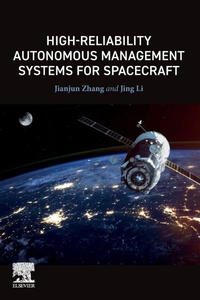
High-Reliability Autonomous Management Systems for Spacecraft
Published on 22. August 2023
Book
Paperback/Softback
206 pages
978-0-443-13283-4 (ISBN)
Description
This book examines the autonomous management of spacecraft, which uses modern control technologies such as artificial intelligence to establish a remote intelligent body on the spacecraft so that the spacecraft can complete its flight tasks by itself. Its goal is to accurately perceive its own state and external environment without relying on external information injection and control, or rely on external control as little as possible, make various appropriate decisions based on this information and user tasks, and be able to autonomously control spacecraft to complete various tasks.
More details
Language
English
Place of publication
Philadelphia
United States
Target group
Professional and scholarly
Product notice
Paperback (trade)
Dimensions
Height: 229 mm
Width: 152 mm
Thickness: 11 mm
Weight
286 gr
ISBN-13
978-0-443-13283-4 (9780443132834)
Copyright in bibliographic data and cover images is held by Nielsen Book Services Limited or by the publishers or by their respective licensors: all rights reserved.
Schweitzer Classification
Other editions
Additional editions
Jianjun Zhang | Jing Li
High-Reliability Autonomous Management Systems for Spacecraft
E-Book
08/2023
Elsevier
€185.00
Available for download
Persons
Dr Jianjun Zhang is a Professor at the China Academy of Space Technology. He is member of the Edge Computing Expert of the China Electronics Society, Chairman of the "Space (Aerospace) Information Technology" Professional Committee of China Electronics Society, and member of the Satellite Application Expert Group of China Aerospace Society. He is mainly engaged in research on satellite navigation system design, advanced spatial information system technology based on cognitive mechanism
Jing Li, Ph.D., is an Associate Professor at the School of Automation, Beijing Institute of Technology. Expert member of the "Space Information Technology? Youth Committee of China Electronics Society, the main research direction is robot environmental awareness, image detection and target tracking, multi-sensor information fusion. She has presided over more than 10 projects including the National Natural Science Youth Fund, the Postdoctoral Special Fund, the Key Laboratory of the Ministry of Education, and the Science and Technology Cooperation. She has published 25 academic papers (including 10 SCI papers and 15 EI papers) and the book "Image Detection and Object Tracking Technology", granted 7 national invention patents as the first author and the National Science and Technology Progress Award 2 (ranked 8th).
Jing Li, Ph.D., is an Associate Professor at the School of Automation, Beijing Institute of Technology. Expert member of the "Space Information Technology? Youth Committee of China Electronics Society, the main research direction is robot environmental awareness, image detection and target tracking, multi-sensor information fusion. She has presided over more than 10 projects including the National Natural Science Youth Fund, the Postdoctoral Special Fund, the Key Laboratory of the Ministry of Education, and the Science and Technology Cooperation. She has published 25 academic papers (including 10 SCI papers and 15 EI papers) and the book "Image Detection and Object Tracking Technology", granted 7 national invention patents as the first author and the National Science and Technology Progress Award 2 (ranked 8th).
Content
Part 1 Introduction
1. Spacecraft Self-Service Management Connotation
2. Spacecraft Systems
Part II Spacecraft Autonomous Health Management
3. Spacecraft Autonomous Health Management Connotation
4. Application Examples of Spacecraft Autonomous Health Management
5. Artificial Intelligence and Health Management
6. Conception of Spacecraft Autonomous Health Management System
Part III Autonomous task management
7. Spacecraft Autonomous Mission Planning Connotation
8. Typical Applications of Spacecraft Autonomous Mission Planning System
9. Conception of Spacecraft Autonomous Mission Management System
Part IV Spacecraft Autonomous Data Management
10. Spacecraft Autonomous Data Management
1. Spacecraft Self-Service Management Connotation
2. Spacecraft Systems
Part II Spacecraft Autonomous Health Management
3. Spacecraft Autonomous Health Management Connotation
4. Application Examples of Spacecraft Autonomous Health Management
5. Artificial Intelligence and Health Management
6. Conception of Spacecraft Autonomous Health Management System
Part III Autonomous task management
7. Spacecraft Autonomous Mission Planning Connotation
8. Typical Applications of Spacecraft Autonomous Mission Planning System
9. Conception of Spacecraft Autonomous Mission Management System
Part IV Spacecraft Autonomous Data Management
10. Spacecraft Autonomous Data Management