

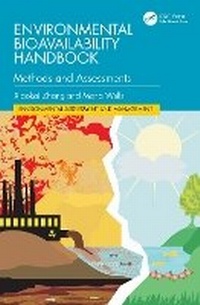
Environmental Bioavailability Handbook
Methods and Assessments
1st Edition
Published on 7. May 2026
Book
Hardback
376 pages
978-1-032-40472-1 (ISBN)
Description
Bioavailability processes are essential for assessing environmental risk, environmental health, and decision-making in environmental management. This practical guide on environmental bioavailability explains its importance and includes specific methods for testing the bioavailability of pollutants in water (freshwater and seawater), soils, and sediments. Detailed methods and techniques are given to measure and assess bioavailability using biotic methods, abiotic methods, and modeling. Case studies help environmental researchers and practitioners understand the applications of bioavailability in field and laboratory.
This book contributes to a deeper understanding of the role of environmental bioavailability in contemporary environmental science in the following ways:
Provides information on the importance of environmental bioavailability of pollutants.
Explains, in a "how-to" manner, the use of environmental bioavailability in the context of Environmental Risk Assessment and environmental management decision-making.
Includes areas of applicability, optimum conditions, and pros and cons for bioavailability methods provided.
Summarizes state-of-the-art in modeling environmental bioavailability and discusses current best practices.
Includes case studies illustrating the assessment of bioavailability using different approaches.
This handbook is intended for professionals, researchers, academics, environmental practitioners, and policymakers working in the areas of Environmental Risk Assessment, environmental health, environmental management, sustainability, and related fields. It is also an excellent resource for students studying in any of these fields and looking for a foundational text on environmental bioavailability.
This book contributes to a deeper understanding of the role of environmental bioavailability in contemporary environmental science in the following ways:
Provides information on the importance of environmental bioavailability of pollutants.
Explains, in a "how-to" manner, the use of environmental bioavailability in the context of Environmental Risk Assessment and environmental management decision-making.
Includes areas of applicability, optimum conditions, and pros and cons for bioavailability methods provided.
Summarizes state-of-the-art in modeling environmental bioavailability and discusses current best practices.
Includes case studies illustrating the assessment of bioavailability using different approaches.
This handbook is intended for professionals, researchers, academics, environmental practitioners, and policymakers working in the areas of Environmental Risk Assessment, environmental health, environmental management, sustainability, and related fields. It is also an excellent resource for students studying in any of these fields and looking for a foundational text on environmental bioavailability.
More details
Series
Language
English
Place of publication
London
United Kingdom
Publishing group
Taylor & Francis Ltd
Target group
College/higher education
Professional and scholarly
Postgraduate, Professional, and Undergraduate Advanced
Illustrations
16 farbige Zeichnungen, 20 s/w Zeichnungen, 24 s/w Tabellen, 28 s/w Photographien bzw. Rasterbilder, 44 s/w Abbildungen, 40 farbige Abbildungen, 20 Farbfotos bzw. farbige Rasterbilder
24 Tables, black and white; 24 Line drawings, color; 12 Line drawings, black and white; 46 Halftones, color; 2 Halftones, black and white; 70 Illustrations, color; 14 Illustrations, black and white
Dimensions
Height: 262 mm
Width: 187 mm
Thickness: 25 mm
Weight
982 gr
ISBN-13
978-1-032-40472-1 (9781032404721)
Copyright in bibliographic data and cover images is held by Nielsen Book Services Limited or by the publishers or by their respective licensors: all rights reserved.
Schweitzer Classification
Other editions
Additional editions
E-Book
05/2026
1st Edition
CRC Press
€231.99
Available for download
E-Book
05/2026
1st Edition
CRC Press
€231.99
Available for download
Persons
Xiaokai Zhang completed his PhD at the University of Liverpool, focusing on topics involving bioavailability in environmental risk and impact assessment, the use of environmental biotechnology to measure bioavailability, and risk-based environmental management interventions. Currently, he is an associate professor at Jiangnan University in Wuxi, Jiangsu Province, China, where he continues to work on topics in bioavailability-based risk and environmental management, as well as the environmental behavior of biochar and remediation of contaminated soils using biochar. His research in his areas of expertise has been published in several book chapters and in notable environmental science journals including Environmental Science & Technology, Water Research, and Environmental Pollution, with some works rated as highly cited papers.
Mona Wells is an interdisciplinary environmental scientist specializing in Environmental Impact Assessment, Environmental Risk Assessment, and environmental management. Her roles have included posts in different locales internationally as an academic and as an environmental practitioner, on projects spanning a broad portfolio including technical project work, research, commercialization, program development, policy advisement, science communication, public consultation, pedagogical development, and continuous improvement.
Mona Wells is an interdisciplinary environmental scientist specializing in Environmental Impact Assessment, Environmental Risk Assessment, and environmental management. Her roles have included posts in different locales internationally as an academic and as an environmental practitioner, on projects spanning a broad portfolio including technical project work, research, commercialization, program development, policy advisement, science communication, public consultation, pedagogical development, and continuous improvement.
Content
Secion 1: Background. 1. Bioavailability and Influencing Factors. 2. Terms and Definitions. 3. Sample Integrity and Avoiding Contamination. 4. Guidance Notes on Quality Assurance and Quality Control. 5. Standard Methods for the Instrumental Analysis of Heavy Metals and Organic Compounds and Ancillary Procedures. Section 2: Biotic Methods: Measurement of "True Bioavailability". 6. Environmental Monitoring of Bioavailability Using Caged Bivalve Mollusks. 7. Using Worms for the Measurement of Pollutant Bioavailability. 8. Assessing the Bioavailability of Pollutants using Macrophytes. 9. Measuring Bioavailability Using Whole-Cell Bioreporters. Section 3: Abiotic Methods: Measurement of Chemoavailability using Chemical Proxies. 10. Chemoavailability of Pollutants Determined by Diffusive Gradients in Thin Films. 11. Tenax Extraction as a Simple Method to Determine the Chemoavailability of Organic Pollutants. 12. Using Chelating Resins for the Measurement of Heavy Metal Bioavailability. 13. Permeation Liquid Membranes as a Tool for Evaluation of Heavy Metal Chemoavailability. Section 4: Modeling. 14. Introduction to Modeling Bioavailability. 15. Speciation and Biotic Ligand Modeling. Section 5: Case Studies on the Assessment of Bioavailability. 16. Case Study: Evaluating Organ-ic Diffusive Gradients in Thin-Film Devices as Proxies to Measure Bioavailability of Methamphetamine in Zebrafish. 17. Case Study: Assessing a Two-in-One Whole-Cell Bioreporter Approach for Bioavailability and Toxicity of Cadmium and Lead.