

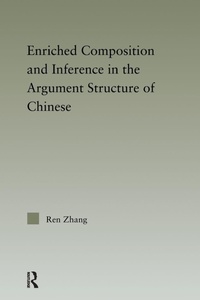
Enriched Composition and Inference in the Argument Structure of Chinese
1st Edition
Published on 21. March 2013
Book
Paperback/Softback
212 pages
978-0-415-84849-7 (ISBN)
Description
As with many other languages, Mandarin Chinese exhibits a rich variety of ways in expressing the arguments of the predicator in a sentence. Unlike other languages, such variation is typically devoid of any formal marking. Previous attempts in explaining such phenomena usually focus on the syntax as an explanatory tool. This book argues that a large majority of such argument structure phenomena are better accounted for by recourse to enriched representations in lexical semantics. Drawing insights from conceptual semantics, cognitive semantics, Generative Lexicon, construction grammar and formal syntax, this book constitutes the first attempt at a comprehensive account of lexical semantic issues in Mandarin Chinese.
More details
Series
Language
English
Place of publication
London
United Kingdom
Publishing group
Taylor & Francis Ltd
Target group
College/higher education
Illustrations
21 s/w Abbildungen
21 Illustrations, black and white
Dimensions
Height: 229 mm
Width: 152 mm
Thickness: 12 mm
Weight
315 gr
ISBN-13
978-0-415-84849-7 (9780415848497)
Copyright in bibliographic data and cover images is held by Nielsen Book Services Limited or by the publishers or by their respective licensors: all rights reserved.
Schweitzer Classification
Other editions
Additional editions
E-Book
10/2005
Routledge
€77.99
Available for download
E-Book
10/2005
Routledge
€77.99
Available for download
Book
05/2005
1st Edition
Routledge
€206.20
Shipment within 15-20 days
Person
Ren Zhang is a visiting professor in linguistics at the School of Foreign Studies, Nanjing University. He received his Ph.D. in Linguistics in 2002 from York University.
Content
Chapter 1: Introduction: Variation in Argument Expression Chapter 2: Constructions, Conceptual Structures and Compositionality Chapter 3: The Eat Restaurant Construction: Licensing Unselected Complements Chapter 4: Conceptual Inference and Predicate Transfer Chapter 5: Concluding Remarks References Index