

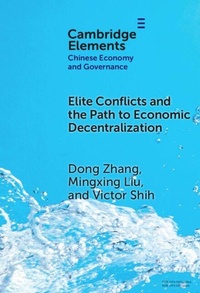
Elite Conflicts and the Path to Economic Decentralization
Published on 30. January 2025
Book
Hardback
106 pages
978-1-009-54480-1 (ISBN)
Description
Why would a politically centralized state embark on the path of economic decentralization? This Element delves into the political origin of the puzzling economic decentralization in mainland China. The authors contend that the intra-elite conflicts between the authoritarian ruler and the ruling elites within the state prompted the ruler to pursue decentralization as a strategy to curb the influence wielded by the ruling elites. By examining the composition of the Chinese Communist Party's Central Committee, they find that the Cultural Revolution, fueled by elite conflicts, shifted the elite selectorate's composition from favoring central agencies to favoring local interests. Subsequent low turnover reinforced this shift, aligning elite incentives with decentralization policies and committing the Chinese leadership to a decentralized path in the 1980s. Additionally, Taiwan's economic liberalization under the Kuomintang's authoritarian rule provides further evidence of the link between ruling party elite composition and economic policy orientation.
More details
Series
Language
English
Place of publication
Cambridge
United Kingdom
Illustrations
Worked examples or Exercises
Dimensions
Height: 235 mm
Width: 157 mm
Thickness: 11 mm
Weight
317 gr
ISBN-13
978-1-009-54480-1 (9781009544801)
Copyright in bibliographic data and cover images is held by Nielsen Book Services Limited or by the publishers or by their respective licensors: all rights reserved.
Schweitzer Classification
Other editions
Additional editions
Dong Zhang | Mingxing Liu | Victor Shih
Elite Conflicts and the Path to Economic Decentralization
Book
01/2025
Cambridge University Press
€27.10
Shipment within 15-20 days
Persons
Content
1. Introduction; 2. The Political Economy of Economic Decentralization; 3. Mainland; 4. Taiwan; 5. Concluding Remarks.