

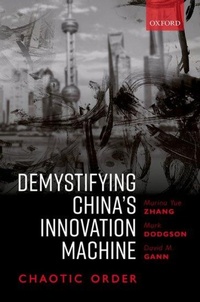
Demystifying China's Innovation Machine
Chaotic Order
Published on 8. December 2021
Book
Hardback
306 pages
978-0-19-886117-1 (ISBN)
Description
China's extraordinary economic development is explained in large part by the way it innovates.
Contrary to widely held views, China's innovation machine is not created and controlled by an all-powerful government. Instead, it is a complex, interdependent system composed of various elements, involving bottom-up innovation driven by innovators and entrepreneurs and highly pragmatic and adaptive top-down policy. Using case studies of leading firms and industries, along with statistics and policy analysis, this book argues that China's innovation machine is similar to a natural ecosystem. Innovations in technology, organization, and business models resemble genetic mutations which are initially random, self-serving, and isolated, but the best fitting are selected by the market and their impacts are amplified by the innovation machine. This machine draws on China's multitude manufacturers, supply chains, innovation clusters, and digitally literate population, connected through super-sized digital platforms.
China's innovation suffers from a lack of basic research and reliance upon certain critical technologies from overseas, yet its scale (size) and scope (diversity) possess attributes that make it self-correcting and stronger in the face of challenges. China's innovation machine is most effective in a policy environment where the market prevails; policy intervention plays a significant role when market mechanisms are premature or fail. The future success of China's innovation will depend on continuing policy pragmatism, mass innovation, and entrepreneurship, and the development of the 'new infrastructures'.
Contrary to widely held views, China's innovation machine is not created and controlled by an all-powerful government. Instead, it is a complex, interdependent system composed of various elements, involving bottom-up innovation driven by innovators and entrepreneurs and highly pragmatic and adaptive top-down policy. Using case studies of leading firms and industries, along with statistics and policy analysis, this book argues that China's innovation machine is similar to a natural ecosystem. Innovations in technology, organization, and business models resemble genetic mutations which are initially random, self-serving, and isolated, but the best fitting are selected by the market and their impacts are amplified by the innovation machine. This machine draws on China's multitude manufacturers, supply chains, innovation clusters, and digitally literate population, connected through super-sized digital platforms.
China's innovation suffers from a lack of basic research and reliance upon certain critical technologies from overseas, yet its scale (size) and scope (diversity) possess attributes that make it self-correcting and stronger in the face of challenges. China's innovation machine is most effective in a policy environment where the market prevails; policy intervention plays a significant role when market mechanisms are premature or fail. The future success of China's innovation will depend on continuing policy pragmatism, mass innovation, and entrepreneurship, and the development of the 'new infrastructures'.
Reviews / Votes
This is a thorough, complex analysis of China's growing technological influence in global development. * S. J. Gabriel, CHOICE * To understand China's economic success, we need to appreciate how it innovates. This book brilliantly explains how China has developed a powerful innovation machine. * Lee Howell, Lee Howell, Senior Advisor, World Economic Forum & Visiting Professor, University of Geneva. Former Managing Director, World Economic Forum * Sustained growth in any economy is driven by continuous technological innovation, including China's miraculous growth since the late 1970s. The interesting questions are how China sustained innovation for decades and whether China can continue its past successes. This book provides answers, based on solid empirical research, to the above important questions. * Justin Yifu Lin, Institute of New Structural Economics, Peking University, Former Chief Economist, World Bank *More details
Language
English
Place of publication
Oxford
United Kingdom
Target group
Professional and scholarly
Product notice
sewn/stitched
Cloth over boards
Dimensions
Height: 238 mm
Width: 164 mm
Thickness: 24 mm
Weight
640 gr
ISBN-13
978-0-19-886117-1 (9780198861171)
Copyright in bibliographic data and cover images is held by Nielsen Book Services Limited or by the publishers or by their respective licensors: all rights reserved.
Schweitzer Classification
Other editions
Additional editions
E-Book
12/2021
1st Edition
OUP eBook
€48.49
Available for download
E-Book
12/2021
1st Edition
OUP eBook
€48.49
Available for download
Persons
Marina Yue Zhang is an associate professor of innovation and entrepreneurship at Swinburne University of Technology. She holds a bachelor's degree in biological sciences from Peking University, and a PhD from Australian National University. She held academic positions at Tsinghua University and UNSW. Before her academic career, Marina worked for IBM and Ericsson, and co-founded two technology startups in China. Her current research looks into innovation ecosystem, technology entrepreneurship, smart manufacturing, and latecomer catch-up in innovation.
Mark Dodgson is Emeritus Professor at the University of Queensland, Australia, and Visiting Professor at Imperial College London, UK. His PhD is from Imperial College London. His previous roles include Executive Director of the National Graduate School of Management at the Australian National University. He has been on the board of two multi-billion dollar companies and five start-ups. He has advised numerous companies and governments throughout Europe, Asia and North, and South America and has researched and taught in over 60 countries.
David Gann is Pro-Vice-Chancellor, Development and External Affairs, and Professor of Innovation & Entrepreneurship at Said Business School and Fellow of Magdalen College, Oxford, UK. He is a Chartered Civil Engineer, Fellow of the Institution of Civil Engineers, Honorary Fellow of the Royal College of Art, and Fellow of the City & Guilds Institute. He is a university and business leader with extensive international experience in innovation strategy and technology management, and has formed 5 companies, mentors start-ups, and advises boards on innovation and technology management. His research explores why and how innovation happens, the ways it continually transforms the world we live in, and how it can be managed.
Mark Dodgson is Emeritus Professor at the University of Queensland, Australia, and Visiting Professor at Imperial College London, UK. His PhD is from Imperial College London. His previous roles include Executive Director of the National Graduate School of Management at the Australian National University. He has been on the board of two multi-billion dollar companies and five start-ups. He has advised numerous companies and governments throughout Europe, Asia and North, and South America and has researched and taught in over 60 countries.
David Gann is Pro-Vice-Chancellor, Development and External Affairs, and Professor of Innovation & Entrepreneurship at Said Business School and Fellow of Magdalen College, Oxford, UK. He is a Chartered Civil Engineer, Fellow of the Institution of Civil Engineers, Honorary Fellow of the Royal College of Art, and Fellow of the City & Guilds Institute. He is a university and business leader with extensive international experience in innovation strategy and technology management, and has formed 5 companies, mentors start-ups, and advises boards on innovation and technology management. His research explores why and how innovation happens, the ways it continually transforms the world we live in, and how it can be managed.
Author
Associate professor of Innovation and EntrepreneurshipAssociate professor of Innovation and Entrepreneurship, Swinburne University of Technology
Emeritus ProfessorEmeritus Professor, University of Queensland
Professor of Innovation and EntrepreneurshipProfessor of Innovation and Entrepreneurship, University of Oxford
Content
Introduction
1: China's Innovation Machine
2: Has China Caught Up in the Global Innovation Race?
3: Effectiveness-Based Manufacturing as a Foundation of China's Innovation Machine
4: China's Mega Supply Chains
5: China's Digital Economy: Survival of the Most Connected
6: Technology Entrepreneurship
7: Institutional Logics in Innovation
8: Chaotic Order: The Future of China's Innovation Machine
1: China's Innovation Machine
2: Has China Caught Up in the Global Innovation Race?
3: Effectiveness-Based Manufacturing as a Foundation of China's Innovation Machine
4: China's Mega Supply Chains
5: China's Digital Economy: Survival of the Most Connected
6: Technology Entrepreneurship
7: Institutional Logics in Innovation
8: Chaotic Order: The Future of China's Innovation Machine