

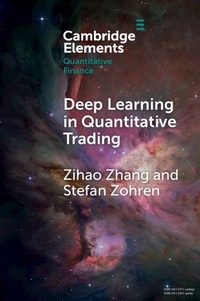
Deep Learning in Quantitative Trading
Published on 30. October 2025
Book
Paperback/Softback
184 pages
978-1-009-70711-4 (ISBN)
Description
This Element provides a comprehensive guide to deep learning in quantitative trading, merging foundational theory with hands-on applications. It is organized into two parts. The first part introduces the fundamentals of financial time-series and supervised learning, exploring various network architectures, from feedforward to state-of-the-art. To ensure robustness and mitigate overfitting on complex real-world data, a complete workflow is presented, from initial data analysis to cross-validation techniques tailored to financial data. Building on this, the second part applies deep learning methods to a range of financial tasks. The authors demonstrate how deep learning models can enhance both time-series and cross-sectional momentum trading strategies, generate predictive signals, and be formulated as an end-to-end framework for portfolio optimization. Applications include a mixture of data from daily data to high-frequency microstructure data for a variety of asset classes. Throughout, they include illustrative code examples and provide a dedicated GitHub repository with detailed implementations.
More details
Series
Language
English
Place of publication
Cambridge
United Kingdom
Product notice
Paperback (trade)
Illustrations
Worked examples or Exercises
Dimensions
Height: 229 mm
Width: 152 mm
Thickness: 11 mm
Weight
276 gr
ISBN-13
978-1-009-70711-4 (9781009707114)
Copyright in bibliographic data and cover images is held by Nielsen Book Services Limited or by the publishers or by their respective licensors: all rights reserved.
Schweitzer Classification
Other editions
Additional editions
Zihao Zhang | Stefan Zohren
Deep Learning in Quantitative Trading
Book
10/2025
Cambridge University Press
€89.30
Shipment within 15-20 days
Persons
Content
Preface; 1. Introduction; Part I. Foundations: 2. Fundamentals of Financial Time-Series; 3. Supervised Learning and Canonical Networks; 4. The Model Training Workflow; Part II. Applications: 5. Enhancing Classical Quantitative Trading Strategies with Deep Learning; 6. Deep Learning for Risk Management and Portfolio Optimization; 7. Applications to Market Microstructure and High-Frequency Data; 8. Conclusions; List of Acronyms; Appendix A: Different Asset Classes; Appendix B: Access to Market Data; Appendix C: Investment Performance Metrics; Appendix D: Code Scripts.