

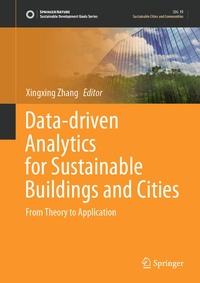
Data-driven Analytics for Sustainable Buildings and Cities
From Theory to Application
Published on 12. September 2021
Book
Hardback
IX, 450 pages
978-981-16-2777-4 (ISBN)
Description
This book explores the interdisciplinary and transdisciplinary fields of energy systems, occupant behavior, thermal comfort, air quality and economic modelling across levels of building, communities and cities, through various data analytical approaches. It highlights the complex interplay of heating/cooling, ventilation and power systems in different processes, such as design, renovation and operation, for buildings, communities and cities. Methods from classical statistics, machine learning and artificial intelligence are applied into analyses for different building/urban components and systems. Knowledge from this book assists to accelerate sustainability of the society, which would contribute to a prospective improvement through data analysis in the liveability of both built and urban environment. This book targets a broad readership with specific experience and knowledge in data analysis, energy system, built environment and urban planning. As such, it appeals to researchers, graduate students, data scientists, engineers, consultants, urban scientists, investors and policymakers, with interests in energy flexibility, building/city resilience and climate neutrality.
More details
Series
Edition
2021 ed.
Language
English
Place of publication
Singapore
Singapore
Target group
Professional and scholarly
Illustrations
50 s/w Abbildungen, 187 farbige Abbildungen
IX, 450 p. 237 illus., 187 illus. in color.
Dimensions
Height: 260 mm
Width: 183 mm
Thickness: 29 mm
Weight
1159 gr
ISBN-13
978-981-16-2777-4 (9789811627774)
DOI
10.1007/978-981-16-2778-1
Schweitzer Classification
Other editions
Additional editions
Book
09/2022
Springer
€235.39
Shipment within 3-4 weeks
E-Book
09/2021
1st Edition
Springer
€223.63
Available for download
Person
Xingxing Zhang is an Associate Professor in energy technology at Dalarna University, Sweden. He has multidisciplinary research experience, especially in energy systems, energy data analytics, adaption to future climate and urban building energy modelling for sustainable transition. He is leading the City Information Modelling (CIM) group at the university, which includes technical, economic, and environmental analyses by interdisciplinary research methods from building physics, energy engineering, informatics, machine learning and artificial intelligence. He is active in EU, UK and China research networks, by working in Swedish national projects, Sweden-China joint project, Nordic research project, EU H2020/FP7 projects, EU cost action and IEA tasks. He has won the second place of "EU-China Dragon-star Innovation Prize" in 2015. He serves as Editor Board Member of two journals and the regular reviewer for many international journals. He has an Accredited Professional Certificate of Leadership in Energy and Environmental Design (LEED AP) and he is UK Chartered Engineer (CEng), Member of Chartered Institution of Building Services Engineers (CIBSE) and CIB Commission Member of W098 Intelligent and Responsive Buildings.
Content
The evolving of data-driven analytics for buildings and cities towards sustainability.- Data-driven approaches for prediction and classification of building energy consumption.- Prediction of occupancy level and energy consumption in office building using blind system identification and neural networks.- Cluster Analysis for Occupant-behaviour based Electricity Load Patterns in Buildings: A Case Study in Shanghai Residences.- A data-driven model predictive control for lighting system based on historical occupancy in an office building: Methodology development.- Tailoring future climate data for building energy simulation.- A solar photovoltaic/thermal (PV/T) concentrator for building application in Sweden using Monte Carlo method.- Influencing factors for occupants' window-opening behaviour in an office building through logistic regression and Pearson correlation approaches.- Reinforcement learning methodologies for controlling occupant comfort in buildings.- A novel Reinforcement learning method for improving occupant comfort via window opening and closing. 2942492291991671341156161