

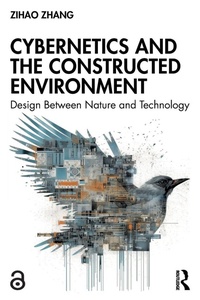
Cybernetics and the Constructed Environment
Design Between Nature and Technology
1st Edition
Published on 25. July 2024
Book
Paperback/Softback
276 pages
978-1-032-34175-0 (ISBN)
Description
Grounded in contemporary landscape architecture theory and practice, Cybernetics and the Constructed Environment blends examples from art, design, and engineering with concepts from cybernetics and posthumanism, offering a transdisciplinary examination of the ramifications of cybernetics on the constructed environment. Cybernetics, or the study of communication and control in animals and machines, has grown increasingly relevant nearly 80 years after its inception. Cyber-physical systems, sensing networks, and spatial computing-algorithms and intelligent machines-create endless feedback loops with human and non-human actors, co-producing a cybernetic environment. Yet, when an ecosystem is meticulously managed by intelligent machines, can we still call it wild nature? Posthumanism ideas, such as new materialism, actor-network theory, and object-oriented ontology, have become increasingly popular among design disciplines, including landscape architecture, and may have provided transformative frameworks to understand this entangled reality. However, design still entails a sense of intentionality and an urge to control. How do we, then, address the tension between the designer's intentionality and the co-produced reality of more-than-human agents in the cybernetic environment? Is posthumanism enough to develop a framework to think beyond our all-too-human ways of thinking? For researchers, scholars, practitioners, and students in environmental design and engineering disciplines, this book maps out a paradigm of environmentalism and ecological design rooted in non-communication and uncontrollability, and puts a speculative turn on cybernetics.
Chapters 8 and 9 of this book are freely available as a downloadable Open Access PDF at http://www.taylorfrancis.com under a Creative Commons Attribution-Non Commercial-No Derivatives (CC-BY-NC-ND) 4.0 license.
Chapters 8 and 9 of this book are freely available as a downloadable Open Access PDF at http://www.taylorfrancis.com under a Creative Commons Attribution-Non Commercial-No Derivatives (CC-BY-NC-ND) 4.0 license.
More details
Language
English
Place of publication
London
United Kingdom
Publishing group
Taylor & Francis Ltd
Target group
College/higher education
Professional and scholarly
Postgraduate, Professional, and Undergraduate Advanced
Illustrations
19 s/w Abbildungen, 8 s/w Photographien bzw. Rasterbilder, 11 s/w Zeichnungen
11 Line drawings, black and white; 8 Halftones, black and white; 19 Illustrations, black and white
Dimensions
Height: 234 mm
Width: 156 mm
Thickness: 16 mm
Weight
442 gr
ISBN-13
978-1-032-34175-0 (9781032341750)
Copyright in bibliographic data and cover images is held by Nielsen Book Services Limited or by the publishers or by their respective licensors: all rights reserved.
Schweitzer Classification
Other editions
Additional editions
E-Book
07/2024
1st Edition
Routledge
€51.49
Available for download
Book
07/2024
1st Edition
Routledge
€206.70
Shipment within 10-20 days
E-Book
07/2024
1st Edition
Routledge
€51.49
Available for download
Person
Zihao Zhang is a designer, educator, and scholar in landscape architecture. He currently serves as an assistant professor and interim director of the landscape architecture program at the City College of New York.
Content
Introduction: The Upscaling of the Cybernetic Imagination Part 1: The New Machine in the New Garden 1. A Transformation Formula 2. The Technology-Nature Edge: From Pastoralism to Anthropocene 3. The Human-Technology Edge: From Ready-made Artefacts to Dematerialized Humans 4. The Human-Nature Edge: The Three Waves of "Nature Study" 5. Posthumanism, Co-Production, and Assemblage Part 2: Posthumanism, the Environment and Intelligent Machines 6. Searching for Nonhuman Agency 7. From Nonhuman Agency to Speculative Ontology 8. Coproductive Intelligence Part 3: The Cybernetic Environment 9. Cybernetics and Landscape: From Uncertainty to Opportunity 10. Reframing Cybernetics 11. Sensing as Coding: The Episteme of the Digital Age 12. The Rise of Intelligent Agents: A Non-Model-Centric Paradigm 13. Actuating Leads to Attuning: Cultivated Wildness 14. Cultivated Wildness and Speculative Ecology Conclusion: Design and Cybernetic Environment