

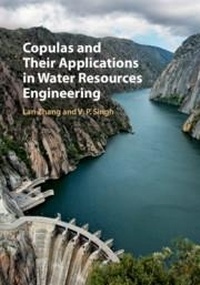
Copulas and their Applications in Water Resources Engineering
Published on 10. January 2019
Book
Hardback
616 pages
978-1-108-47425-2 (ISBN)
Description
Complex environmental and hydrological processes are characterized by more than one correlated random variable. These events are multivariate and their treatment requires multivariate frequency analysis. Traditional analysis methods are, however, too restrictive and do not apply in many cases. Recent years have therefore witnessed numerous applications of copulas to multivariate hydrologic frequency analyses. This book describes the basic concepts of copulas, and outlines current trends and developments in copula methodology and applications. It includes an accessible discussion of the methods alongside simple step-by-step sample calculations. Detailed case studies with real-world data are included, and are organized based on applications, such as flood frequency analysis and water quality analysis. Illustrating how to apply the copula method to multivariate frequency analysis, engineering design, and risk and uncertainty analysis, this book is ideal for researchers, professionals and graduate students in hydrology and water resources engineering.
More details
Language
English
Place of publication
Cambridge
United Kingdom
Target group
Professional and scholarly
College/higher education
Product notice
sewn/stitched
Cloth over boards
Illustrations
Worked examples or Exercises; 4 Maps; 2 Halftones, color; 1 Halftones, black and white; 176 Line drawings, black and white
Dimensions
Height: 254 mm
Width: 179 mm
Thickness: 32 mm
Weight
1363 gr
ISBN-13
978-1-108-47425-2 (9781108474252)
Copyright in bibliographic data and cover images is held by Nielsen Book Services Limited or by the publishers or by their respective licensors: all rights reserved.
Schweitzer Classification
Other editions
Additional editions
E-Book
01/2019
Cambridge University Press
€113.99
Available for download
Lan Zhang | V. P. Singh
Copulas and their Applications in Water Resources Engineering
E-Book
01/2019
Cambridge University Press
€136.99
Available for download
Persons
Lan Zhang currently works as a post-doc research scholar in the Department of Agricultural and Biological Engineering at Texas A & M University. She received her B.S. in Mechanical Engineering, M.S. in Water Resources Sciences, and Ph.D. in Civil and Environmental Engineering. She has written more than forty publications in the areas of hydrology, copulas, water quality, entropy, and water resources. She has been working on copulas and their application in hydrology and water resource engineering for more than ten years. V. P. Singh is Distinguished Professor, Regents Professor, and Caroline and William N. Lehrer Distinguished Chair in Water Engineering at Texas A & M University. Singh has published extensively in the areas of hydrology, groundwater, hydraulics, irrigation, pollutant transport, copulas, entropy, climate change, and water resources. He has received more than 90 national and international awards, including the Arid Lands Hydraulic Engineering Award, Ven Te Chow Award, Richard R. Torrens Award, Norman Medal, and EWRI Lifetime Achievement Award, given by the American Society of Civil Engineers; the Ray K. Linsley Award and Founder's Award, given by the American Institute of Hydrology; the Crystal Drop Award and Ven Te Chow Memorial Award, given by the International Water Resources Association; the Merriam Improved Irrigation Award given by the US Committee on Irrigation and Drainage; the Hancor Soil and Water Engineering Award given by the American Society of Agricultural and Biological Engineers; and three honorary doctorates. He is a Distinguished Member of ASCE, and a fellow of EWRI, AWRA, IWRS, ISAE, IASWC and IE, as well as a member of 10 international science and engineering academies. He has also served as President of the AIH.
Content
1. Introduction; 2. Preliminaries; 3. Copulas and their properties; 4. Symmetric Archimedean copulas; 5. Asymmetric copulas: high dimension; 6. Plackett copula; 7. Non-Archimedean copulas: meta-elliptical copulas; 8. Entropic copulas; 9. Copulas in time series analysis; 10. Rainfall frequency analysis; 11. Flood frequency analysis; 12. Water quality analysis; 13. Drought analysis; 14. Compound extremes; 15. Network design; 16. Suspended sediment yield analysis; 17. Inter-basin transfer; Index.