

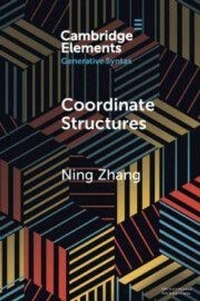
Coordinate Structures
Published on 14. December 2023
Book
Paperback/Softback
88 pages
978-1-009-32663-6 (ISBN)
Description
In a coordination construction, which is universally available, two or more syntactic constituents are combined, with or without an overt coordinator. This Element examines how coordinate structures are derived syntactically, focussing on the syntactic operations involved, including constraints on both their operations and the representations they produce. Specifically, considering the recent research development in the syntax of coordination, the Element discusses whether any special syntactic operation is required to derive various coordinate constructions, including constructions in which each conjunct has a gap, whether there is any special functional category heading coordinate constructions in general, what the morphosyntactic statuses of coordinators (i.e., conjunctions and disjunctions) are in some specific languages, whether the structure of a coordinate construction can be beyond the binary complementation structure, and whether the mobility of conjuncts and the mobility of elements in conjuncts require any construction-specific constraint on syntactic operations.
More details
Series
Language
English
Place of publication
Cambridge
United Kingdom
Product notice
Paperback (trade)
Illustrations
Worked examples or Exercises
Dimensions
Height: 223 mm
Width: 148 mm
Thickness: 8 mm
Weight
128 gr
ISBN-13
978-1-009-32663-6 (9781009326636)
Copyright in bibliographic data and cover images is held by Nielsen Book Services Limited or by the publishers or by their respective licensors: all rights reserved.
Schweitzer Classification
Other editions
Additional editions
Ning Zhang
Coordinate Structures
Book
12/2023
Cambridge University Press
€78.00
Shipment within 15-20 days
Ning Zhang
Coordinate Structures
E-Book
12/2023
Cambridge University Press
€20.99
Available for download
Person
Content
1. Introduction; 2. The syntactic relations between conjuncts; 3. More about the syntax of coordinators; 4. Removing construction-specific syntactic operations; 5. Movement modes in deriving certain coordinate constructions; 6. Conclusions and theoretical considerations.