

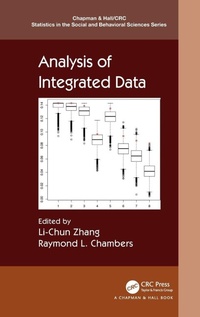
Analysis of Integrated Data
Published on 8. May 2019
Book
Hardback
272 pages
978-1-4987-2798-3 (ISBN)
Description
The advent of "Big Data" has brought with it a rapid diversification of data sources, requiring analysis that accounts for the fact that these data have often been generated and recorded for different reasons. Data integration involves combining data residing in different sources to enable statistical inference, or to generate new statistical data for purposes that cannot be served by each source on its own. This can yield significant gains for scientific as well as commercial investigations.
However, valid analysis of such data should allow for the additional uncertainty due to entity ambiguity, whenever it is not possible to state with certainty that the integrated source is the target population of interest. Analysis of Integrated Data aims to provide a solid theoretical basis for this statistical analysis in three generic settings of entity ambiguity: statistical analysis of linked datasets that may contain linkage errors; datasets created by a data fusion process, where joint statistical information is simulated using the information in marginal data from non-overlapping sources; and estimation of target population size when target units are either partially or erroneously covered in each source.
Covers a range of topics under an overarching perspective of data integration.
Focuses on statistical uncertainty and inference issues arising from entity ambiguity.
Features state of the art methods for analysis of integrated data.
Identifies the important themes that will define future research and teaching in the statistical analysis of integrated data.
Analysis of Integrated Data is aimed primarily at researchers and methodologists interested in statistical methods for data from multiple sources, with a focus on data analysts in the social sciences, and in the public and private sectors.
However, valid analysis of such data should allow for the additional uncertainty due to entity ambiguity, whenever it is not possible to state with certainty that the integrated source is the target population of interest. Analysis of Integrated Data aims to provide a solid theoretical basis for this statistical analysis in three generic settings of entity ambiguity: statistical analysis of linked datasets that may contain linkage errors; datasets created by a data fusion process, where joint statistical information is simulated using the information in marginal data from non-overlapping sources; and estimation of target population size when target units are either partially or erroneously covered in each source.
Covers a range of topics under an overarching perspective of data integration.
Focuses on statistical uncertainty and inference issues arising from entity ambiguity.
Features state of the art methods for analysis of integrated data.
Identifies the important themes that will define future research and teaching in the statistical analysis of integrated data.
Analysis of Integrated Data is aimed primarily at researchers and methodologists interested in statistical methods for data from multiple sources, with a focus on data analysts in the social sciences, and in the public and private sectors.
More details
Series
Language
English
Place of publication
Oxford
United States
Publishing group
Taylor & Francis Inc
Target group
College/higher education
Illustrations
55 s/w Tabellen, 22 s/w Abbildungen, 22 s/w Zeichnungen
55 Tables, black and white; 22 Line drawings, black and white; 22 Illustrations, black and white
Dimensions
Height: 240 mm
Width: 161 mm
Thickness: 19 mm
Weight
578 gr
ISBN-13
978-1-4987-2798-3 (9781498727983)
Copyright in bibliographic data and cover images is held by Nielsen Book Services Limited or by the publishers or by their respective licensors: all rights reserved.
Schweitzer Classification
Other editions
Additional editions
Li-Chun Zhang | Raymond L. Chambers
Analysis of Integrated Data
Book
06/2021
1st Edition
Chapman & Hall/CRC
€78.70
Shipment within 10-20 days
Li-Chun Zhang | Raymond L. Chambers
Analysis of Integrated Data
E-Book
04/2019
1st Edition
Chapman & Hall/CRC
€72.49
Available for download
Li-Chun Zhang | Raymond L. Chambers
Analysis of Integrated Data
E-Book
04/2019
1st Edition
Chapman & Hall/CRC
€72.49
Available for download
Persons
Li-Chun Zhang is Professor in Social Statistics at the University of Southampton, UK, Senior Researcher at Statistics Norway, Norway, and Professor in Official Statistics at the University of Oslo, Norway.
Raymond Chambers is Professor of Statistical Methodology at the University of Wollongong, Australia.
Raymond Chambers is Professor of Statistical Methodology at the University of Wollongong, Australia.
Content
1. Introduction - Ray Chambers 2. On secondary analysis of datasets that cannot be linked without errors - Li-Chun Zhang 3. Capture-recapture methods in the presence of linkage errors - Loredana di Congsiglio, Tiziana Tuoto, Li-Chun Zhang 4. An overview on uncertainty and estimation in statistical matching - Maruo Scanu, Pier Luigi Conti, Daniela Marella 5. Auxiliary variable selection in a statistical matching problem - Marcello D'Orazio, Marco Di Zio, Mauro Scanu 6. Minimal inference from incomplete 2 x 2-tables - Li-Chun Zhang, Raymond L. Chambers 7. Dual and multiple system estimation with fully and partially observed covariates - Van der Heijden et al. 8. Estimating population size in multiple record systems with uncertainty of state identification - Davide Di Cecco 9. Log-linear models of erroneous list data - Li-Chun Zhang 10. Sampling design and analysis using geo-referenced data - Danila Filipponi, Federica Piersimoni, Roberto Benedetti, Maria Michela Dickson, Giuseppe Espa, Diego Giuliani