

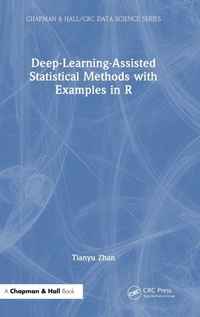
Deep-Learning-Assisted Statistical Methods with Examples in R
1st Edition
Will be published approx. on 17. March 2026
Book
Hardback
186 pages
978-1-041-15845-5 (ISBN)
Description
This book explores how deep learning enhances statistical methods for hypothesis testing, point estimation, optimization, interpretation, and other aspects. It uniquely demonstrates leveraging deep learning to improve traditional statistical approaches, showcasing their superior performance in practical applications. Each topic includes essential background, clear method explanations, and detailed R code demonstrations through case studies. This allows readers to directly apply these methods to their own challenges and easily adapt the underlying principles to related problems.
This book delves into statistical inference, introducing advanced strategies for hypothesis testing and point estimation. These innovative methods ingeniously combine both artificial and human intelligence, offering robust solutions for scenarios where traditional optimal analytical solutions are elusive or non-existent. A prime example of their real-world impact is in adaptive clinical trials, where these computational approaches can be readily implemented to optimize trial design and outcomes. The author further explores the multifaceted benefits of deep-learning-assisted statistical methods, extending beyond mere statistical efficiency. It highlights crucial features such as integrity protection, ensuring the trustworthiness of results; computational efficiency, enabling faster and more scalable analyses; and interpretability, which is increasingly vital for transparent communication of complex findings in modern statistics. This section encourages readers to consider a broader spectrum of improvements for new statistical methods, focusing on attributes that enhance their practical utility and societal relevance. Finally, the reader is given a critical examination of the limitations and potential concerns associated with the methods presented in earlier chapters. Crucially, it doesn't just identify these issues but also offers constructive mitigation approaches. This equips readers with essential techniques to safeguard AI-based methodologies with their scientific expertise, ensuring responsible and valid application of these powerful computational tools in diverse scientific and practical domains.
This book is a valuable resource for students, practitioners, and researchers integrating statistics and data science techniques to solve impactful real-world problems.
This book delves into statistical inference, introducing advanced strategies for hypothesis testing and point estimation. These innovative methods ingeniously combine both artificial and human intelligence, offering robust solutions for scenarios where traditional optimal analytical solutions are elusive or non-existent. A prime example of their real-world impact is in adaptive clinical trials, where these computational approaches can be readily implemented to optimize trial design and outcomes. The author further explores the multifaceted benefits of deep-learning-assisted statistical methods, extending beyond mere statistical efficiency. It highlights crucial features such as integrity protection, ensuring the trustworthiness of results; computational efficiency, enabling faster and more scalable analyses; and interpretability, which is increasingly vital for transparent communication of complex findings in modern statistics. This section encourages readers to consider a broader spectrum of improvements for new statistical methods, focusing on attributes that enhance their practical utility and societal relevance. Finally, the reader is given a critical examination of the limitations and potential concerns associated with the methods presented in earlier chapters. Crucially, it doesn't just identify these issues but also offers constructive mitigation approaches. This equips readers with essential techniques to safeguard AI-based methodologies with their scientific expertise, ensuring responsible and valid application of these powerful computational tools in diverse scientific and practical domains.
This book is a valuable resource for students, practitioners, and researchers integrating statistics and data science techniques to solve impactful real-world problems.
More details
Series
Language
English
Place of publication
London
United Kingdom
Publishing group
Taylor & Francis Ltd
Target group
College/higher education
Professional and scholarly
Postgraduate, Professional Reference, and Undergraduate Advanced
Illustrations
5 s/w Abbildungen, 5 s/w Zeichnungen, 31 s/w Tabellen
31 Tables, black and white; 5 Line drawings, black and white; 5 Illustrations, black and white
Dimensions
Height: 240 mm
Width: 161 mm
Thickness: 15 mm
Weight
446 gr
ISBN-13
978-1-041-15845-5 (9781041158455)
Copyright in bibliographic data and cover images is held by Nielsen Book Services Limited or by the publishers or by their respective licensors: all rights reserved.
Schweitzer Classification
Other editions
Additional editions
E-Book
03/2026
Chapman and Hall
€0.00
Available for download
E-Book
03/2026
Chapman and Hall
€0.00
Available for download
Book
approx. 03/2026
1st Edition
CRC Press
€76.20
Not yet published
Person
Tianyu Zhan is a Director at AbbVie Inc. He obtained his Ph.D. in Biostatistics from the University of Michigan Ann Arbor in 2017. His research interests are closely related to late-phase clinical trials. He has been actively promoting innovative clinical trial designs and advanced analysis methods at AbbVie, resulting in significant business impacts.
Content
I Introduction and Preparations
1. Introduction to Deep Neural Networks (DNNs)
2. How to Implement DNN in Regression
II Statistical Inference
3. Two-sample Parametric Hypothesis Testing
4. Point Estimation
III Numerical Methods
5. Optimization with Unavailable Gradient Information
6. Protect Integrity and Save Computational Time
7. Interpretable Models in Regression Analysis
IV Extensions
8. Substitutions of Other Methods for DNN
9. Limitations and Mitigations
10. Some Future Works
1. Introduction to Deep Neural Networks (DNNs)
2. How to Implement DNN in Regression
II Statistical Inference
3. Two-sample Parametric Hypothesis Testing
4. Point Estimation
III Numerical Methods
5. Optimization with Unavailable Gradient Information
6. Protect Integrity and Save Computational Time
7. Interpretable Models in Regression Analysis
IV Extensions
8. Substitutions of Other Methods for DNN
9. Limitations and Mitigations
10. Some Future Works