

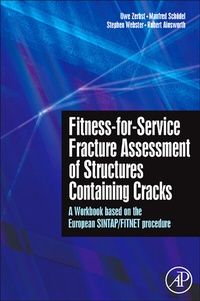
Fitness-for-Service Fracture Assessment of Structures Containing Cracks
A Workbook based on the European SINTAP/FITNET procedure
Published on 12. September 2007
Book
Hardback
320 pages
978-0-08-044947-0 (ISBN)
Description
The purpose of Fitness-for-Service Fracture Assessment of Structures Containing Cracks is to facilitate the use of fracture mechanics based failure assessment procedures for the evaluation and design of structures and components. All practical structures contain flaws and the optimum combination of cost efficiency and safety whilst achieving the required capability, can only be realised by using state of the art methods such as that represented by the European flaw assessment method SINTAP/FITNET to analyse the safety risk. This book is written by practitioners with extensive experience in both the development and use of integrity assessment methods and provides comprehensive information on the basic principles and use of analytical flaw assessment. It provides an introduction to the method, its background, how it can be applied, its potential and, importantly, its limitations. The explanations are complimented by using a large number of worked examples and validation exercises which illustrate all aspects of the procedure. In addition, for students and engineers who are new to the subject, a comprehensive glossary of basic terms used in fracture mechanics based integrity evaluations is included.
The topics addressed include:
Crack driving force (CDF) and failure assessment diagram (FAD) type analyses
Preparation of the input parameters (crack dimensions, stress-strain properties, fracture toughness, statistical aspects)
Determination of the model parameters, (stress intensity factor and yield load solutions)
Treatment of combined primary and secondary loading, together with residual stress effects
Analysis of the effect of constraint effects (treatment of small defects and section size effects)
Treatment of mixed mode loading
Consideration of the influences of strength mismatch
Reliability aspects
The topics addressed include:
Crack driving force (CDF) and failure assessment diagram (FAD) type analyses
Preparation of the input parameters (crack dimensions, stress-strain properties, fracture toughness, statistical aspects)
Determination of the model parameters, (stress intensity factor and yield load solutions)
Treatment of combined primary and secondary loading, together with residual stress effects
Analysis of the effect of constraint effects (treatment of small defects and section size effects)
Treatment of mixed mode loading
Consideration of the influences of strength mismatch
Reliability aspects
Reviews / Votes
"The comprehensiveness of the compilation of the SINTAP/FITNET Procedure in this book, clear outline, worked examples, numerous formulas for important relationships, clear illustrations, an illustrated glossary, a comprehensive subject index: the level of presentation of all these items is excellent and may animate the reader to spend more time on the book than he may have had in mind before he started. This book is written by key experts in the field and is highly recommendable to a wide readership, in particular those engineers who want to be made aware of the latest state of the art of structural assessment." --Dr. Karl-Heinz Schwalbe, Consultant, GermanyThe authors should be commended for making a very useful contribution to the area of fracture assessment of metallic structures. The book comprises a good mix of theory and practical procedures, which are complimented by many worked examples and validation exercises." --Dr Xiang Zhang, Cranfield University, U.K.
"...a very well written, articulate and informative presentation of the European flaw assessment method SINTAP/FITNET... The explanations are complemented by extensive and detailed worked examples and validation exercises illustrating the use of the procedure. This is a very welcome aspect of the book, since frequently the scientific and technical literature provides insufficient help to those wishing to apply the results presented. In summary, this book is an important contribution to the field of structural integrity, failure prevention and assessment, of great value to engineers and scientists working in a wide variety of sectors where metallic structures are used." --Professor P.M.S.T. de Castro, Universidade do Porto, Portugal
More details
Language
English
Place of publication
London
United Kingdom
Publishing group
Elsevier Science & Technology
Target group
Professional and scholarly
University researchers (materials, engineering, mechanics). Researchers in interdisciplinary areas of structural integrity, damage tolerance, failure analysis, NDT. Practitioners in industry such as energy supply, aerospace, chemistry, petrochemicals, pipelines, offshore structures, railways.
Illustrations
Approx. 140 illustrations
Dimensions
Height: 240 mm
Width: 165 mm
Weight
800 gr
ISBN-13
978-0-08-044947-0 (9780080449470)
Copyright in bibliographic data and cover images is held by Nielsen Book Services Limited or by the publishers or by their respective licensors: all rights reserved.
Schweitzer Classification
Other editions
Additional editions
Uwe Zerbst | Manfred Schödel | Stephen Webster
Fitness-for-Service Fracture Assessment of Structures Containing Cracks
A Workbook based on the European SINTAP/FITNET procedure
E-Book
10/2013
Academic Press
€195.00
Available for download
Persons
Content
INTRODUCTION; BRIEF OVERVIEW ON THE DEVELOPMENT OF FLAW ASSESSMENT; BASIC FEATURES OF SINTAP/FITNET; THE INPUT PARAMETERS; THE MODEL PARAMETERS; STRUCTURAL ASSESSMENT; VALIDATION EXAMPLES; REFERENCES; APPENDIX: Fracture Toughness Test Standards; GLOSSARY