

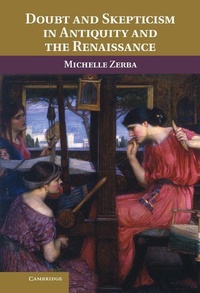
Doubt and Skepticism in Antiquity and the Renaissance
Published on 9. July 2012
Book
Hardback
272 pages
978-1-107-02465-6 (ISBN)
Description
This book is an interdisciplinary study of the forms and uses of doubt in works by Homer, Sophocles, Aristophanes, Cicero, Machiavelli, Shakespeare and Montaigne. Based on close analysis of literary and philosophical texts by these important authors, Michelle Zerba argues that doubt is a defining experience in antiquity and the Renaissance, one that constantly challenges the limits of thought and representation. The wide-ranging discussion considers issues that run the gamut from tragic loss to comic bombast, from psychological collapse to skeptical dexterity and from solitary reflection to political improvisation in civic contexts and puts Greek and Roman treatments of doubt into dialogue not only with sixteenth-century texts but with contemporary works as well. Using the past to engage questions of vital concern to our time, Zerba demonstrates that although doubt sometimes has destructive consequences, it can also be conducive to tolerance, discovery and conversation across sociopolitical boundaries.
Reviews / Votes
'... an extremely well written and jargon-free book that demonstrates the advantages of an interdisciplinary form of interpretation. Doubt and Skepticism [in Antiquity and the Renaissance] should be of interest to scholars in very divergent fields of expertise, not just the speculative philosophers ...' Geert Lernout, Bryn Mawr Classical Review 'Zerba guides her readers over the heavily trafficked terrain of Homer, Sophocles, Aristophanes, Cicero, Machiavelli, Shakespeare, and Montaigne in search of the doubleness in Western thinking that we call doubt.' Kathy Eden, Common Knowledge '... enriches the evergrowing literature on the history of skepticism ...' David L. Sedley, The European Legacy 'Who should read this book? Everyone who loves the great books and finds skepticism appealing; everyone thrilled by the ambition of an argument spanning two millennia but anchored in the rhetoric of key passages; and everyone eager to persuade conservatives, who brandish these texts as their own in the culture wars, that 'there was never a time before interpretation when certainty prevailed'.' Anita Gilman Sherman, Renaissance QuarterlyMore details
Language
English
Place of publication
Cambridge
United Kingdom
Target group
Professional and scholarly
Dimensions
Height: 235 mm
Width: 157 mm
Thickness: 21 mm
Weight
596 gr
ISBN-13
978-1-107-02465-6 (9781107024656)
Copyright in bibliographic data and cover images is held by Nielsen Book Services Limited or by the publishers or by their respective licensors: all rights reserved.
Schweitzer Classification
Other editions
Additional editions
Michelle Zerba
Doubt and Skepticism in Antiquity and the Renaissance
E-Book
07/2012
1st Edition
Cambridge University Press
€82.99
Available for download
Michelle Zerba
Doubt and Skepticism in Antiquity and the Renaissance
E-Book
07/2012
Cambridge University Press
€70.49
Available for download
Person
Michelle Zerba is Associate Professor of English, Classics, and Comparative Literature at Louisiana State University. She is the author of Tragedy and Theory: The Problem of Conflict since Aristotle (1988) and numerous articles on literature, rhetoric and philosophy in antiquity and the Renaissance.
Content
Introduction; Part I. 'Farewell the Tranquil Mind': Tragic Doubt in Homer's Iliad, Sophocles' Philoctetes, and Shakespeare's Othello: 1. Achilles' doubt and the construction of a heroism-at-one-remove in Homer's Iliad; 2. Moral doubt and the contradictory claims of pity in Sophocles' Philoctetes; 3. 'Do as if for surety': doubt and delusions of certainty in Shakespeare's Othello; Part II. Comic Skepticism and Polytropic Strategies in Homer's Odyssey, Aristophanes' Women of the Thesmophoria, and Shakespeare's As You Like It: 4. Wandering Odysseus, pyrrhonist Penelope, and the return from alienation in Homer's Odyssey; 5. Parody, androgyny, and skeptical inversions of gender and genre in Aristophanes' Women of the Thesmophoria and Shakespeare's As You Like It; Part III. Skepticism, Politics, and Rhetoric in the Works of Cicero, Machiavelli, and Montaigne: 6. Skeptical constructions of identity in Roman and Renaissance humanism; 7. Academic skepticism and Cicero's republican politics; 8. A Ciceronian Machiavelli; 9. Montaigne's pyrrhonist politics.