

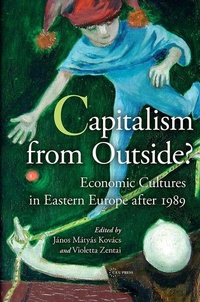
Capitalism from Outside?
Economic Cultures in Eastern Europe after 1989
Published on 10. June 2012
Book
Hardback
362 pages
978-615-5211-33-1 (ISBN)
Description
Does capitalism emerging in Eastern Europe need as solid ethnic or spiritual foundations as some other "Great Transformations" in the past? Apparently, one can become an actor of the new capitalist game without belonging to the German, Jewish, or, to take a timely example, Chinese minority. Nor does one have to go to a Protestant church every Sunday, repeat Confucian truisms when falling asleep, or study Adam Smith's teachings on the virtues of the market in a business course. He/she may just follow certain quasi-capitalist routines acquired during communism and import capitalist culture (more exactly, various capitalist cultures) in the form of down-to-earth cultural practices embedded in freshly borrowed economic and political institutions. Does capitalism come from outside? Why do then so many analysts talk about hybridization? This volume offers empirical insights into the current cultural history of the Eastern European economies in three fields: entrepreneurship, state governance and economic science. The chapters are based on large case studies prepared in the framework of an eight-country research project (funded by the European Commission, and directed jointly by the Center for Public Policy at the Central European University and the Institute for Human Sciences) on East-West cultural encounters in the ex-communist economies.
Reviews / Votes
"The impressive international team of contributors has done a good job. The case studies on the introduction of western banking institutions and culture to various eastern European countries, entrepreneurship, privatization of brewing, transmittal and absorption of western norms, and the adjustment of eastern economics to modern western trends are all highly interesting and convincing on the topic of the 'hybridization' process. As the editors sum up in the prologue, 'the nascent capitalism in the region is much less driven from outside, and its local actors are much more active and inventive' than generally thought. Although cultural exchange was often asymmetric, the authors think that it would be a grave simplifi cation to talk about a 'strong Western' culture that devours the 'weak Eastern' culture'." * Slavic Review *More details
Language
English
Place of publication
Oxford
Hungary
Target group
Professional and scholarly
Academic
Product notice
sewn/stitched
Paper over boards
With dust jacket
Dimensions
Height: 231 mm
Width: 160 mm
Thickness: 25 mm
Weight
676 gr
ISBN-13
978-615-5211-33-1 (9786155211331)
Copyright in bibliographic data and cover images is held by Nielsen Book Services Limited or by the publishers or by their respective licensors: all rights reserved.
Schweitzer Classification
Other editions
Additional editions

Janos Matyas Kovacs | Violetta Zentai
Capitalism from Outside?
Economic Cultures in Eastern Europe after 1989
E-Book
06/2012
1st Edition
Central European University Press
€98.99
Available for download
Persons
Violetta Zentai is Director at the Center for Policy Studies, Central European University.
Janos Matyas Kovacs is Permanent Fellow at the Institute for Human Sciences, Vienna; Lecturer at the Department of Economics, Lorand Eoetvoes University, Budapest; External Research Fellow at the Institute of Economics, Hungarian Academy of Sciences.
Janos Matyas Kovacs is Permanent Fellow at the Institute for Human Sciences, Vienna; Lecturer at the Department of Economics, Lorand Eoetvoes University, Budapest; External Research Fellow at the Institute of Economics, Hungarian Academy of Sciences.
Content
List of Tables About DIOSCURI Prologue: Going beyond Homo Sovieticus Janos Matyas Kovacs and Violetta Zentai Part 1. Entrepreneurship: Smooth Hybridization? Repatriate Entrepreneurship in Serbia. Business Culture within Hauzmajstor Vesna Vucinic-Neskovic A Small Miracle without Foreign Investors. Villany Wine and Westernized Local Knowledge Eva Kovacs From Local to International and Back. Privatizing Brewing Companies in Eastern Europe Ildiko Erdei and Kamil Mares Reason, Charisma, and the Legacy of the Past. Czechs and Italians in Zivnostenska Bank Irena Kasparova Managers as "Cultural Drivers": Raiffeisen Bank in Croatia Drago Cengic The Rise of a Banking Empire in Central and Eastern Europe, Raiffeisen International Violetta Zentai Part 2. State Governance: Unilateral Adjustment? Transmitting Western Norms. The SAPARD Program in Eastern Europe Katalin Kovacs and Petya Kabakchieva Cloning or Hybridization? SAPARD in Romania Florian Nitu Caring Mother and Demanding Father. Cultural Encounters in a Rural Development Program in Bulgaria Haralan Alexandrov and Rafael Chichek Becoming European: Hard Lessons from Serbia. The Topola Rural Development Program Mladen Lazic Part 3. Economic Knowledge: Does Anything Go? Have Polish Economists Noticed New Institutionalism? Jacek Kochanowicz The Sinuous Path of New Institutional Economics in Bulgaria Roumen Avramov Soft Institutionalism: The Reception of New Institutional Economics in Croatia Vojmir Franicevic Institutionalism, the Economic Institutions of Capitalism, and the Romanian Economics Epistemic Community Paul Dragos Aligica and Horia Paul Terpe Beyond Basic Instinct? On the Reception of New Institutional Economics in Eastern Europe Janos Matyas Kovacs Epilogue: Defining the Indefinable: East-West Cultural Encounters Janos Matyas Kovacs and Violetta Zentai List of Contributors Index