

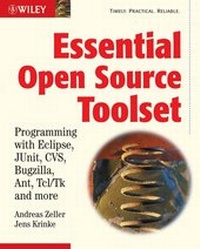
Essential Open Source Toolset
Programming with Eclipse, JUnit, CVS, Bugzilla, Ant, Tcl/Tk and More
1st Edition
Published on 7. January 2005
Book
Paperback/Softback
404 pages
978-0-470-84445-8 (ISBN)
Unfortunately, price unknown
Article is exhausted; no reprint
Description
A unique guide to the classic Linux/Unix Toolset.
Programming is more than just coding. Software developers must build, analyse and test their programs; they have to avoid performance bottlenecks, administer internal and foreign modifications, find and remove errors. Using tools available under Linux/Unix, developers can solve the problems of the programming practice.
* Tools covered are the 'classics' in Linux/Unix environments
* Unique coverage of wide range of tools including: DIFF, PATCH, UNRAVEL, GPROF, GCOV, SniFF+ and many more
* Includes practical exercises to test competence
* Companion Web site includes information on more recent developments as well as extensive additional resources
Programming is more than just coding. Software developers must build, analyse and test their programs; they have to avoid performance bottlenecks, administer internal and foreign modifications, find and remove errors. Using tools available under Linux/Unix, developers can solve the problems of the programming practice.
* Tools covered are the 'classics' in Linux/Unix environments
* Unique coverage of wide range of tools including: DIFF, PATCH, UNRAVEL, GPROF, GCOV, SniFF+ and many more
* Includes practical exercises to test competence
* Companion Web site includes information on more recent developments as well as extensive additional resources
More details
Product info
PB
Edition
1., Auflage
Language
English
Place of publication
Chichester
United Kingdom
Publishing group
John Wiley and Sons Ltd
Target group
College/higher education
Professional and scholarly
Dimensions
Height: 23.5 cm
Width: 19 cm
Thickness: 2.3 cm
Weight
749 gr
ISBN-13
978-0-470-84445-8 (9780470844458)
Schweitzer Classification
Persons
Andreas Zeller is a full professor at the University of Saarbrucken, Germany. His research topics include testing and debugging, program analysis and configuration management. He is widely known for GNU DDD, a Unix/Linux debugger GUI that visualizes complex data and which is used by more than 250,000 users.
Jens Krinke is a research assistant at the University of Passau, Germany. He is an expert in software reengineering and program analysis. His research topic is the analysis of critical software.
Jens Krinke is a research assistant at the University of Passau, Germany. He is an expert in software reengineering and program analysis. His research topic is the analysis of critical software.
Content
Preface.
1. Introduction.
I: VERSION CONTROL.
2. Managing changes using DIFF and PATCH.
3. Revision management using RCS.
4. Parallel Program development with CVS.
Exercises I.
II: PROCESSING INPUT.
5. Lexical analysis using LEX.
6. Syntactical analysis with YACC.
7. Lexical and syntactic analysis using ANTLR.
Exercises II.
III: BUILDING PROGRAMS.
8. Building programs with MAKE.
9. Configuring software automatically with AUTOCONF.
10. Documenting programs with JAVADOC.
Exercises III.
IV: PROTOTYPING.
11. Creating prototypes using Tcl/Tk.
Exercises IV.
V: TESTING AND DEBUGGING.
12. Software tests with DEJAGNU.
13. Component tests with JUNIT.
14. Tracking Problems with BUGZILLA.
15. Debugging with GDB and DDD.
Exercises V.
VI: PROGRAM ANALYSIS.
16. Profiling using GPROF and GCOV.
17. Checking Style with CHECKSTYLE.
18. Static program analysis with LINT.
19. Program slicing using UNRAVEL.
Exercises VI.
VII: INTEGRATED INVIRONMENT.
20. Integrated development with ECLIPSE 3.0.
Exercises VII.
Bibliography.
Index.
1. Introduction.
I: VERSION CONTROL.
2. Managing changes using DIFF and PATCH.
3. Revision management using RCS.
4. Parallel Program development with CVS.
Exercises I.
II: PROCESSING INPUT.
5. Lexical analysis using LEX.
6. Syntactical analysis with YACC.
7. Lexical and syntactic analysis using ANTLR.
Exercises II.
III: BUILDING PROGRAMS.
8. Building programs with MAKE.
9. Configuring software automatically with AUTOCONF.
10. Documenting programs with JAVADOC.
Exercises III.
IV: PROTOTYPING.
11. Creating prototypes using Tcl/Tk.
Exercises IV.
V: TESTING AND DEBUGGING.
12. Software tests with DEJAGNU.
13. Component tests with JUNIT.
14. Tracking Problems with BUGZILLA.
15. Debugging with GDB and DDD.
Exercises V.
VI: PROGRAM ANALYSIS.
16. Profiling using GPROF and GCOV.
17. Checking Style with CHECKSTYLE.
18. Static program analysis with LINT.
19. Program slicing using UNRAVEL.
Exercises VI.
VII: INTEGRATED INVIRONMENT.
20. Integrated development with ECLIPSE 3.0.
Exercises VII.
Bibliography.
Index.