

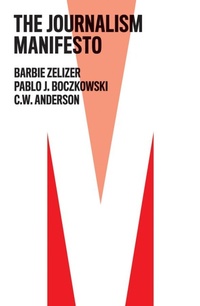
The Journalism Manifesto
1st Edition
Published on 29. October 2021
Book
Paperback/Softback
140 pages
978-1-5095-4264-2 (ISBN)
Description
Drawing on the collaborative expertise of three senior scholars, The Journalism Manifesto makes a powerful case for why journalism has become outdated and why it is in need of a long-overdue transformation.
Focusing on the relevance of elites, norms and audiences, Zelizer, Boczkowski and Anderson reveal how these previously integral components of journalism have become outdated: Elites, the sources from which journalists draw much of their information and around whom they orient their coverage, have become dysfunctional; The relevance of norms, the cues by which journalists do newswork, has eroded so fundamentally that journalists are repeatedly entrenching themselves as negligible and out of sync; and because audiences have shattered beyond recognition, the correspondence between what journalists think of as news and what audiences care about can no longer be assumed.
This authoritative manifesto argues that journalism has become decoupled from the dynamics of everyday life in contemporary society and outlines pathways for fixing this essential institution of democracy. It is a must-read for students, scholars and activists in the fields of journalism, media, policy, and political communication.
Focusing on the relevance of elites, norms and audiences, Zelizer, Boczkowski and Anderson reveal how these previously integral components of journalism have become outdated: Elites, the sources from which journalists draw much of their information and around whom they orient their coverage, have become dysfunctional; The relevance of norms, the cues by which journalists do newswork, has eroded so fundamentally that journalists are repeatedly entrenching themselves as negligible and out of sync; and because audiences have shattered beyond recognition, the correspondence between what journalists think of as news and what audiences care about can no longer be assumed.
This authoritative manifesto argues that journalism has become decoupled from the dynamics of everyday life in contemporary society and outlines pathways for fixing this essential institution of democracy. It is a must-read for students, scholars and activists in the fields of journalism, media, policy, and political communication.
More details
Series
Language
English
Place of publication
Oxford
United Kingdom
Target group
Professional and scholarly
Dimensions
Height: 186 mm
Width: 122 mm
Thickness: 12 mm
Weight
154 gr
ISBN-13
978-1-5095-4264-2 (9781509542642)
Copyright in bibliographic data and cover images is held by Nielsen Book Services Limited or by the publishers or by their respective licensors: all rights reserved.
Schweitzer Classification
Other editions
Additional editions
Barbie Zelizer | Pablo J. Boczkowski | C. W. Anderson
The Journalism Manifesto
E-Book
11/2021
1st Edition
Wiley
€10.99
Available for download
Barbie Zelizer | Pablo J. Boczkowski | C. W. Anderson
The Journalism Manifesto
Book
10/2021
1st Edition
Polity Press
€60.50
Shipment within 15-20 days
Persons
Barbie Zelizer is a former journalist and the Raymond Williams Professor of Communication, and the Director of the Scholars Program in Culture and Communication at the Annenberg School for Communication.
Pablo J. Boczkowski is Hamad Bin Khalifa Al-Thani Professor in the Department of Communication Studies and Director of the Center for Latinx Digital Media at Northwestern University.
C.W Anderson is Professor of Media and Communication at the University of Leeds.
Pablo J. Boczkowski is Hamad Bin Khalifa Al-Thani Professor in the Department of Communication Studies and Director of the Center for Latinx Digital Media at Northwestern University.
C.W Anderson is Professor of Media and Communication at the University of Leeds.
Content
Acknowledgments
Chapter 1. Journalism in the Imagination and on the Ground
Chapter 2. Elites
Chapter 3. Norms
Chapter 4. Audiences
Chapter 5. Reform or Revolution?
References
Chapter 1. Journalism in the Imagination and on the Ground
Chapter 2. Elites
Chapter 3. Norms
Chapter 4. Audiences
Chapter 5. Reform or Revolution?
References