

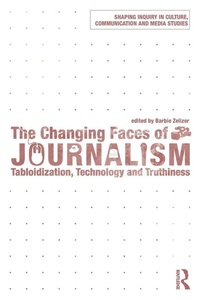
The Changing Faces of Journalism
Tabloidization, Technology and Truthiness
1st Edition
Published on 1. May 2009
Book
Paperback/Softback
192 pages
978-0-415-77825-1 (ISBN)
Description
The collection is introduced with an essay by Barbie Zelizer and organized into three sections: how tabloidization affects the journalistic landscape; how technology changes what we think we know about journalism; and how 'truthiness' tweaks our understanding of the journalistic tradition. Short section introductions contextualise the essays and highlight the issues that they raise, creating a coherent study of journalism today.
Reviews / Votes
"These essays invite the reader to see the opportunities for the renewal of journalism and contribute significant discussion to the debate over journalism's future...Highly recommended." -CHOICEMore details
Series
Language
English
Place of publication
London
United Kingdom
Publishing group
Taylor & Francis Ltd
Target group
College/higher education
Product notice
Paperback (UK-B)
Dimensions
Height: 234 mm
Width: 156 mm
Thickness: 11 mm
Weight
301 gr
ISBN-13
978-0-415-77825-1 (9780415778251)
Copyright in bibliographic data and cover images is held by Nielsen Book Services Limited or by the publishers or by their respective licensors: all rights reserved.
Schweitzer Classification
Other editions
Additional editions
E-Book
05/2009
1st Edition
Routledge
€60.49
Available for download
E-Book
05/2009
1st Edition
Routledge
€60.49
Available for download
Book
05/2009
1st Edition
Routledge
€206.00
Shipment within 15-20 days
Person
Barbie Zelizer is the Raymond Williams Professor of Communication and Director of the Scholars Program in Culture and Communication at the University of Pennsylvania's Annenberg School for Communication. A former journalist, Zelizer is known for her work in the area of journalism, culture, memory and images, particularly in times of crisis. Previous publications for Routledge include Reporting War: Journalism in Wartime (2004) and Journalism After September 11 (2002) (both co-edited with Stuart Allan) and Explorations in Communication and History (2008).
Content
Introduction: Why Journalism's Changing Faces Matter. Barbie Zelizer Part 1: On Tabloidization 1. Rethinking a Villain, Redeeming a Format: The Crisis and Cure in Tabloidization. Michael Serazio 2. Can Popularization Help the News Media?
Herbert J. Gans 3. Tears and Trauma in the News. Carolyn Kitch 4. Tabloidization: What Is It and Does It Really Matter? S. Elizabeth BirdPart 2: On Technology 5. The Impact of Technology on Journalism. Lokman Tsui 6. Materiality and Mimicry in Contemporary Journalistic Practice. Pablo Boczkowski 7. The Guardian of the Real: Journalism in the Time of the New Mind. Julianne H. Newton 8. Technology and the Individual Journalist: Agency Beyond Imitation and Change. Mark DeuzePart 3: On Truthiness 9. Rethinking Truth through Truthiness. Keren Tenenboim-Weinblatt 10. Two Cheers for Positivism: Factual Knowledge in the Age of Truthiness. Michael Schudson 11. The Moment of Truthiness. James Ettema 12. Believable Fictions: Redactional Culture and the Will to Truthiness. Jeffrey Jones Afterword: The Troubling Evolution of Journalism. Peter Dahlgren.
Herbert J. Gans 3. Tears and Trauma in the News. Carolyn Kitch 4. Tabloidization: What Is It and Does It Really Matter? S. Elizabeth BirdPart 2: On Technology 5. The Impact of Technology on Journalism. Lokman Tsui 6. Materiality and Mimicry in Contemporary Journalistic Practice. Pablo Boczkowski 7. The Guardian of the Real: Journalism in the Time of the New Mind. Julianne H. Newton 8. Technology and the Individual Journalist: Agency Beyond Imitation and Change. Mark DeuzePart 3: On Truthiness 9. Rethinking Truth through Truthiness. Keren Tenenboim-Weinblatt 10. Two Cheers for Positivism: Factual Knowledge in the Age of Truthiness. Michael Schudson 11. The Moment of Truthiness. James Ettema 12. Believable Fictions: Redactional Culture and the Will to Truthiness. Jeffrey Jones Afterword: The Troubling Evolution of Journalism. Peter Dahlgren.