

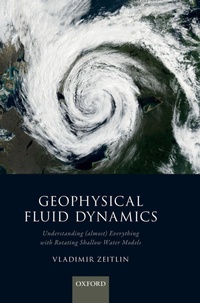
Geophysical Fluid Dynamics
Understanding (almost) everything with rotating shallow water models
Published on 15. February 2018
Book
Hardback
512 pages
978-0-19-880433-8 (ISBN)
Description
Geophysical fluid dynamics examines the dynamics of stratified and turbulent motion of fluids in the ocean and outer core, and of gases in the atmosphere. This book explains key notions and fundamental processes of the dynamics of large- and medium-scale atmospheric and oceanic motions from the unifying viewpoint of the rotating shallow water model. The model plays a distinguished role in geophysical fluid dynamics. It has been used for about a century for conceptual understanding of various phenomena, for elaboration of approaches and methods to be used later in more complete models, for development and testing of numerical codes, and for many other purposes. In spite of its simplicity, the model grasps essential features of the complete "primitive equations" models, being their vertically averaged version, and gives an intuitive representation and clear vision of principal dynamical processes.
This book is a combination of a course on geophysical fluid dynamics (Part 1), with explanations and illustrations of fundamentals, and problems, as well as a more advanced treatise of a range of principal dynamical phenomena (Part 2), including recently arisen approaches and applications (Part 3). Mathematics and physics underlying dynamical phenomena are explained, with necessary demonstrations. Yet, an important goal of the book is to develop the reader's physical intuition and qualitative insights.
This book is a combination of a course on geophysical fluid dynamics (Part 1), with explanations and illustrations of fundamentals, and problems, as well as a more advanced treatise of a range of principal dynamical phenomena (Part 2), including recently arisen approaches and applications (Part 3). Mathematics and physics underlying dynamical phenomena are explained, with necessary demonstrations. Yet, an important goal of the book is to develop the reader's physical intuition and qualitative insights.
More details
Language
English
Place of publication
Oxford
United Kingdom
Target group
Professional and scholarly
College/higher education
Illustrations
Over 230 illustrations
Dimensions
Height: 250 mm
Width: 175 mm
Thickness: 32 mm
Weight
1050 gr
ISBN-13
978-0-19-880433-8 (9780198804338)
Copyright in bibliographic data and cover images is held by Nielsen Book Services Limited or by the publishers or by their respective licensors: all rights reserved.
Schweitzer Classification
Other editions
Additional editions
Vladimir Zeitlin
Geophysical Fluid Dynamics
Understanding (almost) Everything with Rotating Shallow Water Models
Book
09/2024
Oxford University Press
€61.00
Shipment within 15-20 days

Vladimir Zeitlin
Geophysical Fluid Dynamics
Understanding (almost) everything with rotating shallow water models
E-Book
02/2018
1st Edition
OUP eBook
€122.99
Available for download
Person
Vladimir Zeitlin graduated from Dnipropetrovsk University (Ukraine) in 1976, and gained his PhD in theoretical and mathematical physics in 1980 from the Physical Institute (Moscow). Trained as a theoretical physicist, he moved his focus to geophysical fluid dynamics in the early 1980s. He worked at the Institute of Atmospheric Physics (Moscow) on vortex dynamics, wave-vortex interactions and turbulence. Later, after moving to France, Zeitlin joined the Laboratory of Dynamical Meteorology and then became Professor at the University P. and M. Curie (now Sorbonne University) and Ecole Normale Superieure (Paris).
Content
PART I: Modelling Large-Scale Oceanic and Atmospheric Flows: From Primitive to Rotating Shallow Water Equations and Beyond
1: Introduction
2: Primitive equations model
3: Simplifying primitive equations: rotating shallow water models and their properties
4: Wave motions in rotating shallow water with boundaries, topography, at the equator, and in laboratory
5: Getting rid of fast waves: slow dynamics
6: Vortex dynamics on the f- and beta- plane and wave radiation
7: Rotating shallow water models as quasilinear hyperbolic systems, and related numerical methods
PART II: Understanding Fundamental Dynamical Phenomena with Rotating Shallow Water Models
8: Geostrophic adjustment and wave-vortex (non)interaction
9: RSW modons, and their surprising properties. RSW turbulence
10: Instabilities of jets and fronts and their nonlinear evolution
11: Instabilities in cylindrical geometry: vortices and laboratory flows
12: Resonant wave interactions and resonant excitation of waveguide modes
13: Wave turbulence
PART II: Generalisations of Standard Rotating Shallow-Water Model, and Their Applications
14: Rotating shallow-water models with horizontal density and/or temperature gradients
15: Rotating shallow-water models with moist convection
16: Rotating shallow-water models with full Coriolis force
1: Introduction
2: Primitive equations model
3: Simplifying primitive equations: rotating shallow water models and their properties
4: Wave motions in rotating shallow water with boundaries, topography, at the equator, and in laboratory
5: Getting rid of fast waves: slow dynamics
6: Vortex dynamics on the f- and beta- plane and wave radiation
7: Rotating shallow water models as quasilinear hyperbolic systems, and related numerical methods
PART II: Understanding Fundamental Dynamical Phenomena with Rotating Shallow Water Models
8: Geostrophic adjustment and wave-vortex (non)interaction
9: RSW modons, and their surprising properties. RSW turbulence
10: Instabilities of jets and fronts and their nonlinear evolution
11: Instabilities in cylindrical geometry: vortices and laboratory flows
12: Resonant wave interactions and resonant excitation of waveguide modes
13: Wave turbulence
PART II: Generalisations of Standard Rotating Shallow-Water Model, and Their Applications
14: Rotating shallow-water models with horizontal density and/or temperature gradients
15: Rotating shallow-water models with moist convection
16: Rotating shallow-water models with full Coriolis force